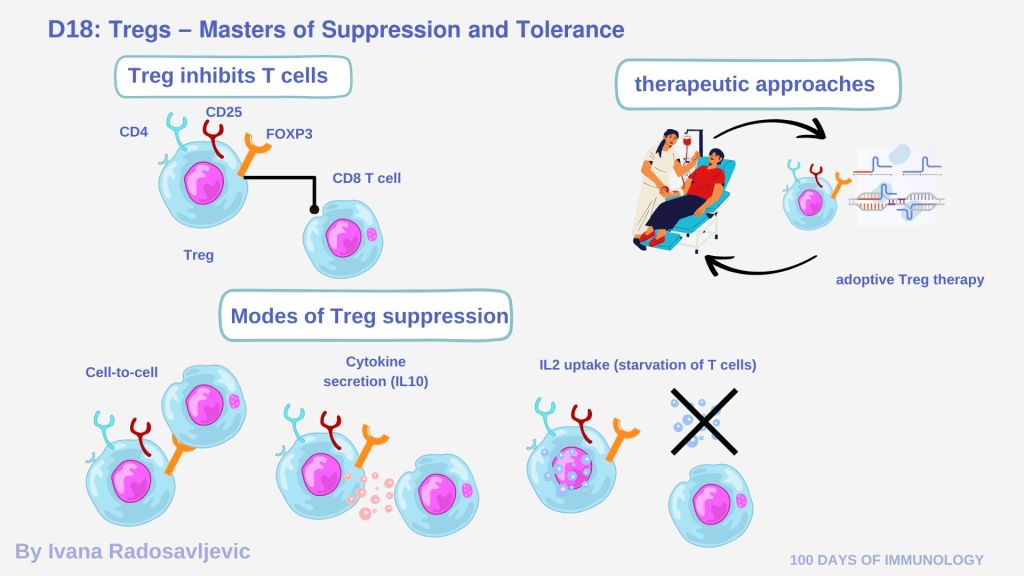
Regulatory T cells (Tregs), defined by CD4, CD25, and FOXP3, are central to immune homeostasis. They 𝘱𝘳𝘦𝘷𝘦𝘯𝘵 𝘢𝘶𝘵𝘰𝘪𝘮𝘮𝘶𝘯𝘪𝘵𝘺 𝘣𝘺 𝘴𝘶𝘱𝘱𝘳𝘦𝘴𝘴𝘪𝘯𝘨 𝘦𝘹𝘤𝘦𝘴𝘴𝘪𝘷𝘦 𝘪𝘮𝘮𝘶𝘯𝘦 𝘳𝘦𝘴𝘱𝘰𝘯𝘴𝘦𝘴 and modulating effector cells through cytokine secretion, metabolic regulation, and cell–cell interactions [1].
𝗠𝗲𝗰𝗵𝗮𝗻𝗶𝘀𝗺𝘀 𝗼𝗳 𝗧𝗿𝗲𝗴-𝗠𝗲𝗱𝗶𝗮𝘁𝗲𝗱 𝗦𝘂𝗽𝗽𝗿𝗲𝘀𝘀𝗶𝗼𝗻
Tregs control immune responses through several mechanisms:
𝘊𝘦𝘭𝘭–𝘤𝘦𝘭𝘭 𝘤𝘰𝘯𝘵𝘢𝘤𝘵: Direct inhibition of effector T cells.
𝘊𝘺𝘵𝘰𝘬𝘪𝘯𝘦 𝘴𝘦𝘤𝘳𝘦𝘵𝘪𝘰𝘯: IL-10 and TGF-β dampen effector cell function.
𝘔𝘦𝘵𝘢𝘣𝘰𝘭𝘪𝘤 𝘳𝘦𝘨𝘶𝘭𝘢𝘵𝘪𝘰𝘯: Consumption of IL-2 and other nutrients limits effector T cell activity [1].
𝗖𝗹𝗶𝗻𝗶𝗰𝗮𝗹 𝗥𝗲𝗹𝗲𝘃𝗮𝗻𝗰𝗲
𝘈𝘶𝘵𝘰𝘪𝘮𝘮𝘶𝘯𝘦 𝘥𝘪𝘴𝘦𝘢𝘴𝘦𝘴: Suppression of autoreactive T cells, e.g., in EAE.
𝘊𝘢𝘯𝘤𝘦𝘳: Tumor recruitment of Tregs dampens antitumor immunity.
𝘛𝘳𝘢𝘯𝘴𝘱𝘭𝘢𝘯𝘵𝘢𝘵𝘪𝘰𝘯: Promotes graft acceptance and tolerance induction.
𝗧𝗵𝗲𝗿𝗮𝗽𝗲𝘂𝘁𝗶𝗰 𝗮𝗽𝗽𝗿𝗼𝗮𝗰𝗵𝗲𝘀 include adoptive Treg transfer, pharmacological modulation, and 𝘦𝘯𝘨𝘪𝘯𝘦𝘦𝘳𝘪𝘯𝘨 𝘰𝘧 𝘛𝘳𝘦𝘨𝘴 for enhanced function [1].
𝗚𝗲𝗿𝗺𝗮𝗻 𝗥𝗲𝘀𝗲𝗮𝗿𝗰𝗵𝗲𝗿𝘀 𝗼𝗻 𝗧𝗿𝗲𝗴𝘀
Anke Fuchs (University Hospital Dresden) focuses on CAR-engineered Tregs (Treg CARs) and GMP-compliant production for adoptive cell therapy. Her work bridges basic Treg biology with clinical application in transplantation and autoimmunity [2].
Oliver Goldmann’s group (Helmholtz Centre for Infection Research, Braunschweig) studies Treg-mediated immunosuppression in infection and inflammation, revealing mechanisms underlying immune balance [3].
Niklas Beumer’s group (Helmholtz Munich) investigates induced regulatory T cells (iTregs), particularly targeting RBPJ to improve stability and therapeutic potential [4].
𝗦𝗽𝗲𝗰𝘂𝗹𝗮𝘁𝗶𝘃𝗲 𝗛𝘆𝗽𝗼𝘁𝗵𝗲𝘀𝗶𝘀: 𝗧𝗿𝗲𝗴𝘀 𝗮𝘀 “𝗜𝗺𝗺𝘂𝗻𝗲 𝗢𝗽𝘁𝗶𝗺𝗶𝘇𝗲𝗿𝘀”
Tregs may function as dynamic “immune optimizers,” integrating signals from effector T cells and antigen-presenting cells to fine-tune immune responses. This self-organizing behavior allows efficient balancing of pathogen defense with self-tolerance [3,4].
Stay tuned for 𝗗𝗮𝘆 𝟭𝟵: 𝗡𝗞𝗧 𝗖𝗲𝗹𝗹𝘀 – 𝗕𝗿𝗶𝗱𝗴𝗶𝗻𝗴 𝗜𝗻𝗻𝗮𝘁𝗲 𝗮𝗻𝗱 𝗔𝗱𝗮𝗽𝘁𝗶𝘃𝗲 𝗜𝗺𝗺𝘂𝗻𝗶𝘁𝘆
𝗥𝗲𝗳𝗲𝗿𝗲𝗻𝗰𝗲𝘀
1. DOI: 10.1016/j.cell.2008.05.009
2. DOI: 10.3389/fimmu.2019.00038
3. https://doi.org/10.3389/fimmu.2024.1328193
4. DOI: 10.1038/s41392-025-02284-x
#100DaysOfImmunology #Tregs #RegulatoryTCells #ImmuneTolerance #Autoimmunity #CancerImmunology #Transplantation #GermanResearchers #CAR_Tregs #GMP #FOXP3 #ImmuneSuppression #Immunotherapy
 Ivana Radosavljević | Immunotherapy Scientist | Living and Breathing Immunology