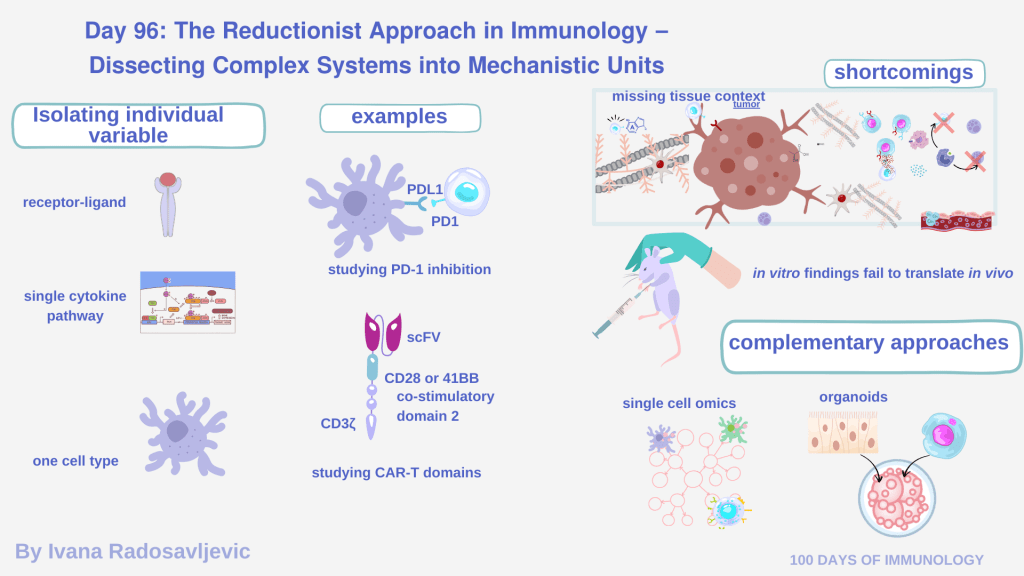
Immunology system is one of the most complex in biology: a dynamic, adaptive network of cells, signals, tissues, and feedback loops. To study this complexity, researchers have traditionally relied on a reductionist approach.
𝗠𝗲𝗮𝗻𝗶𝗻𝗴
Reductionism focuses on isolating individual variables: a single receptor–ligand interaction, one cytokine pathway, one immune cell type. Classic examples include studying TCR signaling in purified T cells, knocking out a single gene in mice, or testing one cytokine in vitro [1].
𝗪𝗵𝘆 𝗱𝗼 𝘄𝗲 𝘂𝘀𝗲 𝗶𝘁 𝗶𝗻 𝗶𝗺𝗺𝘂𝗻𝗼𝗹𝗼𝗴𝘆?
Reductionism enables mechanistic clarity. Without it, concepts like PD-1 inhibition, CAR-T signaling domains, or IL-2–driven T cell expansion would not exist. It allows reproducibility, hypothesis-driven experiments [2].
𝗧𝗵𝗲 𝘀𝗵𝗼𝗿𝘁𝗰𝗼𝗺𝗶𝗻𝗴𝘀
The immune system is not isolated from the body. Cells behave differently in tissues than in cell culture wells, and signaling pathways interact in nonlinear ways. Reductionist models fail to capture:
• Tissue context (e.g., tumor microenvironment, lymphoid architecture)
• Cellular crosstalk
• Temporal dynamics and feedback loops
Consequently, findings that are robust 𝘪𝘯 𝘷𝘪𝘵𝘳𝘰 may not translate 𝘪𝘯 𝘷𝘪𝘷𝘰 or clinically [3].
𝗕𝗲𝘆𝗼𝗻𝗱 𝗿𝗲𝗱𝘂𝗰𝘁𝗶𝗼𝗻𝗶𝘀𝗺: 𝗰𝗼𝗺𝗽𝗹𝗲𝗺𝗲𝗻𝘁𝗮𝗿𝘆 𝗮𝗽𝗽𝗿𝗼𝗮𝗰𝗵𝗲𝘀
Modern immunology integrates systems biology, single-cell omics, spatial transcriptomics, organoids, and 𝘪𝘯 𝘷𝘪𝘷o models to bridge this gap. Rather than replacing reductionism, these approaches build on it connecting isolated mechanisms back into higher-order immune behavior [4].
𝗤𝘂𝗲𝘀𝘁𝗶𝗼𝗻 𝗳𝗼𝗿 𝘁𝗵𝗲 𝗮𝘂𝗱𝗶𝗲𝗻𝗰𝗲:
How do you decide when a system is ´complex enough´ to require integrative or systems-level approaches?
Stay tuned for 𝗗𝗮𝘆 𝟵𝟳: 𝗡𝗼𝗻-𝗛𝗼𝗱𝗴𝗸𝗶𝗻 𝗟𝘆𝗺𝗽𝗵𝗼𝗺𝗮 – 𝗜𝗺𝗺𝘂𝗻𝗼𝗹𝗼𝗴𝗶𝗰𝗮𝗹 𝗢𝗿𝗶𝗴𝗶𝗻𝘀, 𝗠𝗼𝗹𝗲𝗰𝘂𝗹𝗮𝗿 𝗛𝗲𝘁𝗲𝗿𝗼𝗴𝗲𝗻𝗲𝗶𝘁𝘆, 𝗮𝗻𝗱 𝗧𝗵𝗲𝗿𝗮𝗽𝗲𝘂𝘁𝗶𝗰 𝗜𝗺𝗽𝗹𝗶𝗰𝗮𝘁𝗶𝗼𝗻𝘀
𝗥𝗲𝗳𝗲𝗿𝗲𝗻𝗰𝗲𝘀
1. ISBN: 978-0-393-88487-6
2. ISBN: 9780443283581
3. PMCID: PMC3902221
4. DOI: 10.1146/annurev-immunol-042617-053035
#Immunology #SystemsImmunology #Reductionism #TranslationalResearch #CancerImmunology #ExperimentalDesign #100DaysOfImmunology
 Ivana Radosavljević | Immunotherapy Scientist | Living and Breathing Immunology