One of the less openly discussed bottlenecks of autologous CAR-T therapies is the biological age and functional state of the patient’s T cells. Most CAR-T recipients are older, heavily pre-treated (chemotherapy/targeted therapy) patients, their T cells often enter manufacturing already compromised.
𝗔𝗻𝗲𝗰𝗱𝗼𝘁𝗲
While exploring literature on senolytic CAR-T cell engineered T cells designed to eliminate senescent cells I realized how easily concepts of senescence and exhaustion are mixed. In an informal discussion with our CSO, we agreed on a crucial point: senescence and exhaustion must not be mixed or treated interchangeably.
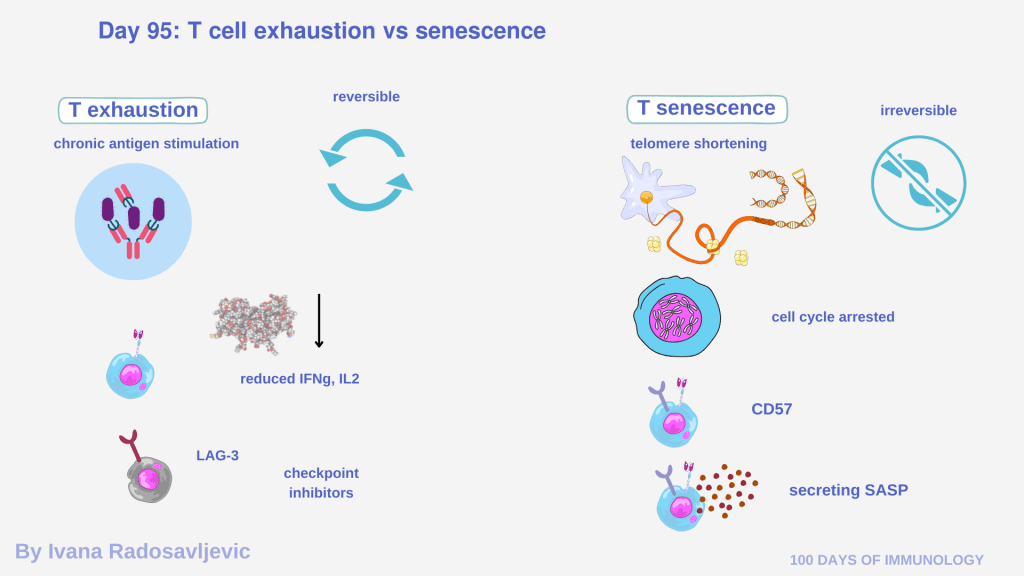
𝗪𝗵𝗮𝘁 𝗶𝘀 𝗧 𝗰𝗲𝗹𝗹 𝗲𝘅𝗵𝗮𝘂𝘀𝘁𝗶𝗼𝗻?
T cell exhaustion arises from chronic antigen stimulation (in cancer and persistent viral infections). Exhausted T cells remain alive but show:
• Reduced effector function (↓ IFN-γ, TNF-α, IL-2)
• expression of inhibitory receptors such as PD-1, TIM-3, LAG-3
• Distinct transcriptional/epigenetic programs
• Exhaustion is adaptive and potentially reversible [1,2].
𝗪𝗵𝗮𝘁 𝗶𝘀 𝗧 𝗰𝗲𝗹𝗹 𝘀𝗲𝗻𝗲𝘀𝗰𝗲𝗻𝗰𝗲?
T cell senescence is linked to replicative aging, telomere shortening, DNA damage, and metabolic stress. Senescent T cells:
• Are cell-cycle arrested (↑ p16^INK4a, p21)
• Lose proliferative capacity
• express CD57, KLRG1
• Can secrete pro-inflammatory factors (SASP)
• Unlike exhaustion, senescence is irreversible [3].
𝗪𝗵𝘆 𝗱𝗼𝗲𝘀 𝘁𝗵𝗶𝘀 𝗺𝗮𝘁𝘁𝗲𝗿 𝗳𝗼𝗿 𝗖𝗔𝗥-𝗧 𝘁𝗵𝗲𝗿𝗮𝗽𝘆?
Exhausted CAR-T cells may still be rescued via checkpoint modulation, or epigenetic reprogramming.
Senescent CAR-T cells, have limited expansion, poor persistence, and reduced 𝘪𝘯 𝘷𝘪𝘷o efficacy no matter how good the CAR design. This distinction is critical when discussing advanced strategies such as:
• Selecting less-differentiated T cell subsets (T-SCM) for manufacturing [4]
• Genetic interventions (e.g., c-JUN overexpression to resist exhaustion)
• Exploring senolytic CAR-T cells as a separate therapeutic concept, not a fix for exhausted CAR-Ts
𝗤𝘂𝗲𝘀𝘁𝗶𝗼𝗻 𝗳𝗼𝗿 𝘁𝗵𝗲 𝗮𝘂𝗱𝗶𝗲𝗻𝗰𝗲
If you were designing next-gen CAR-T therapy:
Would you focus on reversing exhaustion, bypassing senescence, or switching to allogeneic therapy?
Stay tuned for 𝗗𝗮𝘆 𝟵𝟲: 𝗧𝗵𝗲 𝗥𝗲𝗱𝘂𝗰𝘁𝗶𝗼𝗻𝗶𝘀𝘁 𝗔𝗽𝗽𝗿𝗼𝗮𝗰𝗵 𝗶𝗻 𝗜𝗺𝗺𝘂𝗻𝗼𝗹𝗼𝗴𝘆 – 𝗗𝗶𝘀𝘀𝗲𝗰𝘁𝗶𝗻𝗴 𝗖𝗼𝗺𝗽𝗹𝗲𝘅 𝗦𝘆𝘀𝘁𝗲𝗺𝘀 𝗶𝗻𝘁𝗼 𝗠𝗲𝗰𝗵𝗮𝗻𝗶𝘀𝘁𝗶𝗰 𝗨𝗻𝗶𝘁𝘀
𝗥𝗲𝗳𝗲𝗿𝗲𝗻𝗰𝗲𝘀
1. DOI: 10.1038/nri3862
2. DOI: 10.1146/annurev-immunol-041015-055318
3. DOI: 10.1038/nri2959
4. DOI: 10.1038/nm.2446
#Immunology #CARTcells #TcellBiology #Immunotherapy #CellTherapy #CancerResearch #AgingAndImmunity #100Daysofimmunology
 Ivana Radosavljević | Immunotherapy Scientist | Living and Breathing Immunology