Immune engineering uses programmable cellular circuits, logic-gated responses, and light-responsive control systems to design immune cells [1].
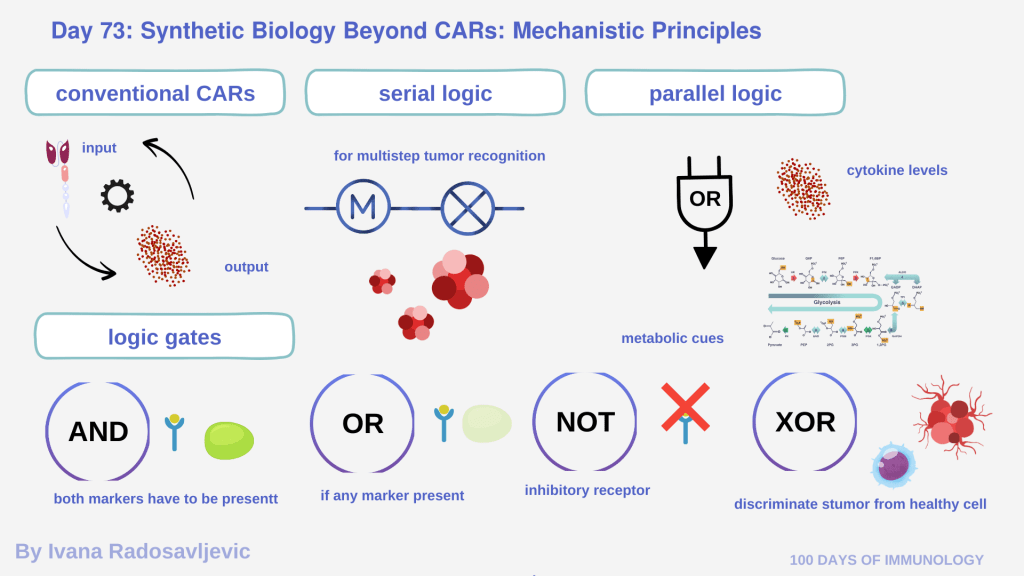
Classical first-generation CARs function as single-input single-output devices: one antigen → one activation signal.
Serial (cascade) Logic enables sequential dependency:
Signal A must occur before signal B
Useful for temporal control, multi-step tumor recognition, or context-dependent activation [2].
Parallel Circuits
Parallel circuits process multiple inputs simultaneously:
• cytokine levels
• antigen combinations
• metabolic cues
• microenvironmental stress signals
In a parallel system, immune cells may activate only when two or more antigens are present (AND logic), suppress activation if a checkpoint is detected (NOT logic), or switch between effector programs (OR logic) [3]. These architectures support treatment of antigen-heterogeneous cancers.
𝗟𝗼𝗴𝗶𝗰 𝗚𝗮𝘁𝗲𝘀 𝗮𝗻𝗱 𝗖𝗲𝗹𝗹𝘂𝗹𝗮𝗿 𝗗𝗲𝗰𝗶𝘀𝗶𝗼𝗻-𝗠𝗮𝗸𝗶𝗻𝗴
Engineered immune circuits increasingly incorporate Boolean logic:
• AND gates → activation only when multiple tumor markers are present
• OR gates → activation if any of several markers appear
• NOT gates → inhibitory receptors suppress activation in healthy tissues
• XOR gates → discriminate tumor from healthy cells with overlapping antigen profiles [2].
𝗢𝗽𝘁𝗼𝗴𝗲𝗻𝗲𝘁𝗶𝗰𝘀 𝗮𝗻𝗱 𝗟𝗶𝗴𝗵𝘁-𝗥𝗲𝘀𝗽𝗼𝗻𝘀𝗶𝘃𝗲 𝗜𝗺𝗺𝘂𝗻𝗼𝗺𝗼𝗱𝘂𝗹𝗮𝘁𝗶𝗼𝗻
Synthetic biology also incorporates light-sensitive domains, including amber-light biosensors, which enable remote, non-invasive, and reversible control of immune cells [4].
These photoreceptors can be engineered into signaling proteins to regulate:
• receptor activation
• cytokine secretion
• cell migration
Light-controlled CAR-T cell activity could allow clinicians to spatially and temporally tune immune function with precision.
𝗘𝗻𝗴𝗶𝗻𝗲𝗲𝗿𝗶𝗻𝗴 𝗕𝗲𝘆𝗼𝗻𝗱 𝗖𝗔𝗥𝘀: The Future Landscape
Other synthetic biology tools:
• Drug-inducible switches regulating activation, proliferation, or apoptosis
• Kill switches for safety, eliminating modified cells in case of toxicity
• Metabolic rewiring to enhance function in hypoxic or nutrient-deprived tumor microenvironments [3]
Question for The Audience: Which modality excites you the most?
Stay tuned for 𝗗𝗮𝘆 𝟳𝟰: 𝗖𝗔𝗥 𝗱𝗲𝘀𝗶𝗴𝗻 𝗲𝗻𝗴𝗶𝗻𝗲𝗲𝗿𝗶𝗻𝗴
𝗥𝗲𝗳𝗲𝗿𝗲𝗻𝗰𝗲𝘀
1. DOI: 10.1111/imr.13244
2. DOI: 10.1146/annurev-immunol-051116-052302
3. DOI: 10.1126/science.abc1855
4. DOI: 10.1038/s41467-022-33891-9
#SyntheticBiology #ImmunoEngineering #LogicGates #CellCircuits #Optogenetics #LightControlledImmunity #CARdesign #NextGenCellTherapy #TcellEngineering #BiologicalComputing #ImmunoOncology #100DaysofImmunology
 Ivana Radosavljević | Immunotherapy Scientist | Living and Breathing Immunology