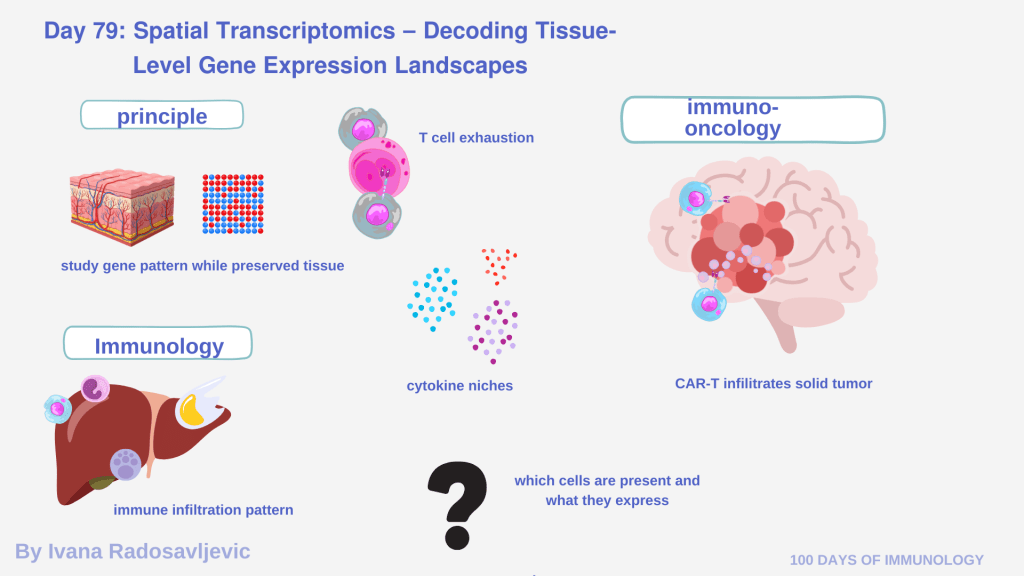
Spatial transcriptomics enables scientists to quantify gene expression while preserving the tissue architecture. This technology bridges the gap between histology and modern sequencing by mapping transcriptional profiles directly onto tissue sections. Researchers obtain highly resolved ´molecular maps´ of immune interactions that would be lost in dissociated single-cell approaches [1].
𝗜𝗻 𝗶𝗺𝗺𝘂𝗻𝗼𝗹𝗼𝗴𝘆, these maps provide insights into:
• Immune infiltration patterns: distinguishing hot, cold, and immune-excluded tumors.
• Spatial gradients of T cell exhaustion, regulatory T cell zones, or myeloid immunosuppression [2].
• Localization of cytokine and chemokine niches, shaping immune cell positioning.
• The interplay between stromal fibroblasts and infiltrating lymphocytes, for understanding resistance to checkpoint blockade.
𝗜𝗻 𝗶𝗺𝗺𝘂𝗻𝗼-𝗼𝗻𝗰𝗼𝗹𝗼𝗴𝘆, spatial transcriptomics is used to assess how CAR-T cells migrate into solid tumors, to identify spatially heterogeneous antigen expression, and to characterize escape niches where immunotherapies fail. For solid tumor CAR-T development, combining ST with imaging mass cytometry or multiplex IF is a powerful translational approach [3].
German Groups:
• Prof. Dr. Niels Halama (NCT Heidelberg / DKFZ) – a pioneer in tumor immune microenvironment mapping, especially immune cell spatial architecture in solid tumors.
• Prof. Dr. Fabian Theis (Helmholtz Zentrum München) – global leader in computational single-cell and spatial transcriptomics, developing algorithms for immune and inflammatory tissues.
• Prof. Dr. Christian Conrad (MDC Berlin) – spatial systems biology approaches to chronic inflammation.
𝗦𝗽𝗮𝘁𝗶𝗮𝗹 Transcriptomics 𝗶𝗻 𝗜𝗺𝗺𝘂𝗻𝗼𝘁𝗵𝗲𝗿𝗮𝗽𝘆
ST allows researchers to evaluate:
• Which cells are present
• What they express
• Where they localize relative to tumor barriers, vasculature, and stromal classes
• How immune landscapes reorganize under treatment.
Question for The Audience: If you could spatially map the immune landscape of any disease autoimmunity, fibrosis, solid tumors, chronic infection, what would you choose?
Stay tuned for 𝗗𝗮𝘆 𝟴𝟬: 𝗣𝗿𝗶𝗻𝗰𝗶𝗽𝗹𝗲𝘀 𝗮𝗻𝗱 Applications o𝗳 𝗦i𝗻𝗴𝗹e-𝗖𝗲𝗹𝗹 𝗥𝗡𝗔 𝗦𝗲𝗾𝘂𝗲𝗻𝗰𝗶𝗻𝗴 𝗶𝗻 𝗜𝗺𝗺𝘂𝗻𝗼𝗹𝗼𝗴𝘆
𝗥𝗲𝗳𝗲𝗿𝗲𝗻𝗰𝗲𝘀
[1] Ståhl et al., Science, 2016.
[2] Jerby-Arnon et al., Cell, 2018.
[3] Ravi et al., Nat Rev Cancer, 2022.
#SpatialTranscriptomics #Immunology #ImmunoOncology #TumorMicroenvironment #SystemsBiology #SingleCell #CancerResearch #HighDimensionalBiology #100Daysofimmunology
 Ivana Radosavljević | Immunotherapy Scientist | Living and Breathing Immunology