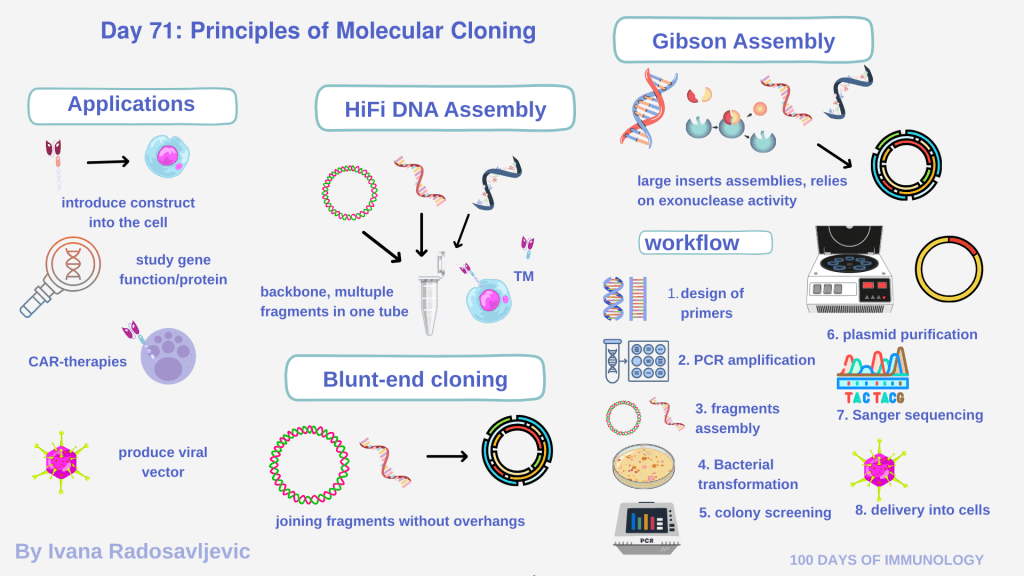
Molecular cloning remains one of the most essential techniques in biotechnology, immunotherapy development, and synthetic biology.
𝗣𝘂𝗿𝗽𝗼𝘀𝗲
• Insert synthetic constructs, mutated variants, and regulatory elements
• Study gene function, protein expression
• Engineer CAR-T cells, CAR-NK, oncolytic viruses, and BiTEs
• Build gene circuits
• Produce therapeutic proteins and viral vectors
Cellular reprogramming.
HiFi DNA Assembly
One tube cloning. HiFi Assembly allows joining of DNA fragments with overlapping homology. It relies on coordinated exonuclease resection, annealing, polymerase gap filling, and ligation. Its high efficiency and capacity to join multiple fragments make it ideal for building modular therapeutic constructs such as CAR libraries [2].
Blunt-End Cloning
Blunt-end ligation joins DNA fragments without overhangs. Although less efficient, it is useful for PCR products generated by proofreading polymerases or when restriction sites are limited [3].
Gibson Assembly
Gibson Assembly is built on exonuclease resection, annealing, polymerase extension, and ligase sealing, enabling construction of multi-fragment assemblies up to hundreds of kilobases [1]. It remains a cornerstone of synthetic biology and large construct engineering.
Standard Workflow of Molecular Cloning
• Design of primers and homologous overlaps
• PCR amplification of vector and insert(s)
• Assembly using HiFi (or any other)
• Transformation into competent E. coli
• Colony screening (PCR, restriction digest)
• Plasmid purification
• Sanger sequencing for verification
• Delivery into mammalian cells (transfection, electroporation, or viral transduction)
• Functional validation through expression assays, reporter measurements, flow cytometry
Laboratory Anecdote
During my cloning experience, I could not transform my bacteria with ligated construct. A postdoc from another group suggested using SOC medium. It was more expensive than standard broth, and my supervisor insisted cheaper media had always worked for his group. But when I switched to SOC, the transformation efficiency improved immediately! Now, with more experience, I recognise that cloning failures are mostly methodological/biological.
Stay tuned for 𝗗𝗮𝘆 𝟳𝟮: 𝗖𝗥𝗜𝗦𝗣𝗥 𝗶𝗻 𝗜𝗺𝗺𝘂𝗻𝗼𝗹𝗼𝗴𝘆
𝗥𝗲𝗳𝗲𝗿𝗲𝗻𝗰𝗲𝘀
1. DOI: 10.1038/nmeth.1318
2. https://lnkd.in/e7eQ2xYN
3. https://lnkd.in/eZ3nw7ju
4. DOI: 10.1016/j.ccell.2020.07.005
5. DOI: 10.1038/s41467-020-15053-x
#MolecularCloning #GeneticEngineering #SyntheticBiology #CloningMethods #GibsonAssembly #HiFiCloning #LabMethods #VectorDesign #CARengineering #BiotechResearch #LifeSciences #100DaysOfImmunology
 Ivana Radosavljević | Immunotherapy Scientist | Living and Breathing Immunology