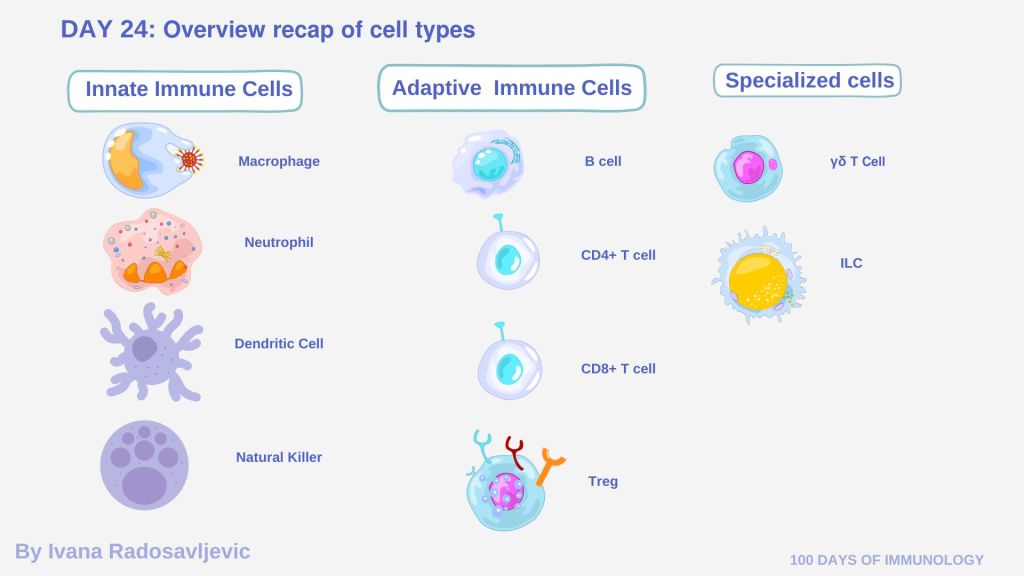
The human immune system is a complex network of specialized cells. Over the past days, we have explored selected immune cell populations, and potential applications in research and therapy. 𝘛𝘰𝘥𝘢𝘺’𝘴 𝘱𝘰𝘴𝘵 𝘴𝘦𝘳𝘷𝘦𝘴 𝘢𝘴 𝘢 𝘣𝘳𝘪𝘦𝘧 𝘳𝘦𝘤𝘢𝘱 𝘰𝘧 𝘵𝘩𝘦 𝘬𝘦𝘺 𝘤𝘦𝘭𝘭 𝘵𝘺𝘱𝘦𝘴 𝘤𝘰𝘷𝘦𝘳𝘦𝘥 𝘴𝘰 𝘧𝘢𝘳.
𝗜𝗻𝗻𝗮𝘁𝗲 𝗜𝗺𝗺𝘂𝗻𝗲 𝗖𝗲𝗹𝗹𝘀
We began with the frontline defenders of immunity.
Posts introduced 𝘮𝘢𝘤𝘳𝘰𝘱𝘩𝘢𝘨𝘦𝘴 (Day 12 – link), versatile phagocytes that also shape tissue repair;
𝘯𝘦𝘶𝘵𝘳𝘰𝘱𝘩𝘪𝘭𝘴 (Day 11 – link), rapid responders critical for acute inflammation; and 𝘥𝘦𝘯𝘥𝘳𝘪𝘵𝘪𝘤 𝘤𝘦𝘭𝘭𝘴 (Day 13 – link), the master antigen-presenters linking innate and adaptive immunity.
We also explored 𝘕𝘒 𝘤𝘦𝘭𝘭s (Day 14 link), innate lymphocytes capable of recognizing stressed or infected cells without prior sensitization.
𝗔𝗱𝗮𝗽𝘁𝗶𝘃𝗲 𝗜𝗺𝗺𝘂𝗻𝗲 𝗖𝗲𝗹𝗹𝘀
The adaptive arm was represented by 𝘉 𝘤𝘦𝘭𝘭𝘴 (Day 15 – link), the source of antibodies and immunological memory.
We examined 𝘊𝘋4+ 𝘩𝘦𝘭𝘱𝘦𝘳 𝘛 𝘤𝘦𝘭𝘭𝘴 (Day 16 – link), which orchestrate immune responses, and 𝘊𝘋8+ 𝘤𝘺𝘵𝘰𝘵𝘰𝘹𝘪𝘤 𝘛 𝘤𝘦𝘭𝘭𝘴 (Day 17 – link), which eliminate infected or malignant cells.
We also looked into 𝘳𝘦𝘨𝘶𝘭𝘢𝘵𝘰𝘳𝘺 𝘛 𝘤𝘦𝘭𝘭𝘴 (𝘛𝘳𝘦𝘨𝘴) (Day 18 – link), critical for maintaining tolerance and preventing autoimmunity.
𝗡𝗼𝗻-𝗖𝗹𝗮𝘀𝘀𝗶𝗰𝗮𝗹 𝗮𝗻𝗱 𝗦𝗽𝗲𝗰𝗶𝗮𝗹𝗶𝘇𝗲𝗱 𝗦𝘂𝗯𝘀𝗲𝘁𝘀
We explored some specialized subsets such as γδ 𝘛 𝘤𝘦𝘭𝘭𝘴 (Day 23 – link), which combine innate and adaptive immunity, and 𝘪𝘯𝘯𝘢𝘵𝘦 𝘭𝘺𝘮𝘱𝘩𝘰𝘪𝘥 𝘤𝘦𝘭𝘭𝘴 (𝘐𝘓𝘊𝘴) (Day 20 – link]), which fine-tune immune responses in barrier tissues.
𝗖𝗹𝗼𝘀𝗶𝗻𝗴 𝗧𝗵𝗼𝘂𝗴𝗵𝘁𝘀
This series has so far only scratched the surface of the immune system’s cellular diversity. I hope you are aware 𝘵𝘩𝘦𝘳𝘦 𝘢𝘳𝘦 𝘥𝘰𝘻𝘦𝘯𝘴 𝘢𝘯𝘥 𝘩𝘶𝘯𝘥𝘳𝘦𝘥𝘴 𝘰𝘧 𝘤𝘦𝘭𝘭 𝘵𝘺𝘱𝘦𝘴 that I cannot cover here. Happy digging into the literature. 😎
𝙒𝙝𝙖𝙩 𝙞𝙨 𝙮𝙤𝙪𝙧 𝙛𝙖𝙫𝙤𝙧𝙞𝙩𝙚 𝙞𝙢𝙢𝙪𝙣𝙚 𝙘𝙚𝙡𝙡 𝙩𝙮𝙥𝙚?
Stay tuned for 𝗗𝗮𝘆 𝟮𝟱: 𝗥𝗲𝗳𝗹𝗲𝗰𝘁𝗶𝗼𝗻𝘀 𝗼𝗻 𝟮𝟰 𝗗𝗮𝘆𝘀 𝗼𝗳 𝗟𝗲𝗮𝗿𝗻𝗶𝗻𝗴
#100DaysOfImmunology #ImmuneCells #ImmunologyRecap #InnateImmunity #AdaptiveImmunity #Macrophages #Neutrophils #DendriticCells #NKCells #BCells #TCells #Tregs #GammaDeltaTCells #ILCs #ImmunologyEducation #ImmuneSystem
 Ivana Radosavljević | Immunotherapy Scientist | Living and Breathing Immunology