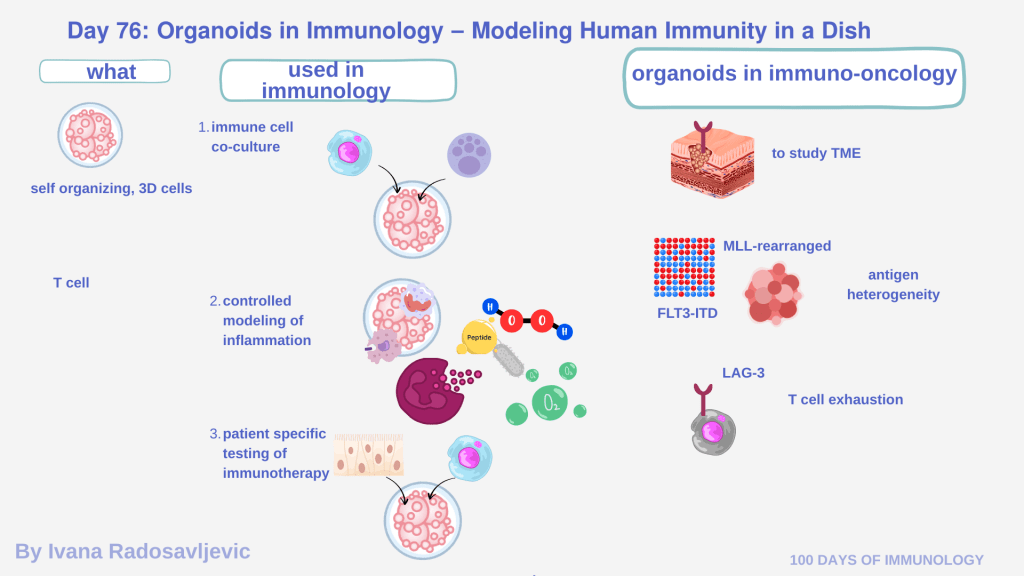
Organoids, self-organizing 3D mini-tissues derived from stem cells, have become one of the most powerful tools in modern immunology and translational research. Organoids preserve tissue architecture, cellular heterogeneity, signaling gradients, and patient-specific mutations [1].
Why organoids matter in immunology
Organoids enable:
• Immune cell co-cultures (T cells, NK cells, macrophages)
• Controlled modeling of inflammation, immune evasion, and cytokine responses
• Patient-specific testing of immunotherapies
• High-throughput immune drug screening
This makes them especially valuable in cancer immunology.
𝗣𝗜𝘀 𝗼𝗳𝘁𝗲𝗻 𝘃𝗮𝗹𝘂𝗲 𝗰𝗮𝗻𝗱𝗶𝗱𝗮𝘁𝗲𝘀 𝘄𝗶𝘁𝗵 𝗲𝘅𝗽𝗲𝗿𝗶𝗲𝗻𝗰𝗲 𝗶n:
• iPSC differentiation
• organoids/spheroids
• 3D ALI culture
• Multi-cell co-cultures (e.g., THP-1 + HUVECs)
These skills indicate:
• Multidimensional thinking
• Comfort with matrix-based culture, growth-factor cocktails, and long-term maintenance
• Familiarity with heterogeneity, gradient biology, and tissue-level analysis
• ALI and cell co-cultures build intuition for mechanistic immunology and tissue biology.
Organoids in immuno-oncology:
Tumoroids (patient-derived tumor organoids) are now key to studying:
• Solid tumor resistance mechanisms
• Antigen heterogeneity
• Immune exclusion
• T-cell exhaustion and stromal barriers
They enable direct testing of CAR-T or NK cell infiltration and killing in solid tumors, providing a preclinical preview of therapeutic potency and toxicity [2].
This is especially critical, as solid tumors require understanding:
• Extracellular matrix
• Immunosuppressive cytokines
• CAF-driven barriers
• Hypoxia
𝗦𝗽𝗲𝗰𝘂𝗹𝗮𝘁𝗶𝘃𝗲 𝗛𝘆𝗽𝗼𝘁𝗵𝗲𝘀𝗶𝘀
Could organoid–immune co-cultures eventually predict cytokine release syndrome (CRS) or therapy-induced toxicity in advance?
German groups leading the field:
DKFZ Heidelberg – tumor organoids and immune co-cultures
Charité Berlin – infection and mucosal immunity organoids
Würzburg University – iPSC immunology and cancer organoids
𝗤𝘂𝗲𝘀𝘁𝗶𝗼𝗻 𝗳𝗼𝗿 𝘁𝗵𝗲 𝗔𝘂𝗱𝗶𝗲𝗻𝗰𝗲
If you could create one organoid model to study an immune mechanism –
Which tissue and immune cell type would you combine, and why?
Stay tuned for 𝗗𝗮𝘆 𝟳7: 𝗠𝗶𝗰𝗿𝗼𝗳𝗹𝘂𝗶𝗱𝗶𝗰𝘀 – 𝗠𝗶𝗰𝗿𝗼𝗲𝗻𝘃𝗶𝗿𝗼𝗻𝗺𝗲𝗻𝘁 𝗠𝗼𝗱𝗲𝗹𝗶𝗻𝗴 𝗮𝗻𝗱 𝗣𝗿𝗲𝗰𝗶𝘀𝗶𝗼𝗻 Immunology
𝗥𝗲𝗳𝗲𝗿𝗲𝗻𝗰𝗲𝘀
1. DOI: 10.1038/s41568-018-0007-6
2. DOI: 10.1016/j.cell.2018.07.009
3. DOI: 10.1186/s13619-020-00059-z
4. DOI: 10.1016/j.cell.2019.11.036
#Organoids #Immunology #ImmunoOncology #3DCellCulture #PrecisionMedicine #CARTEngineering #iPSC #TranslationalResearch #CellTherapy #CancerBiology #100DaysofImmunology
 Ivana Radosavljević | Immunotherapy Scientist | Living and Breathing Immunology