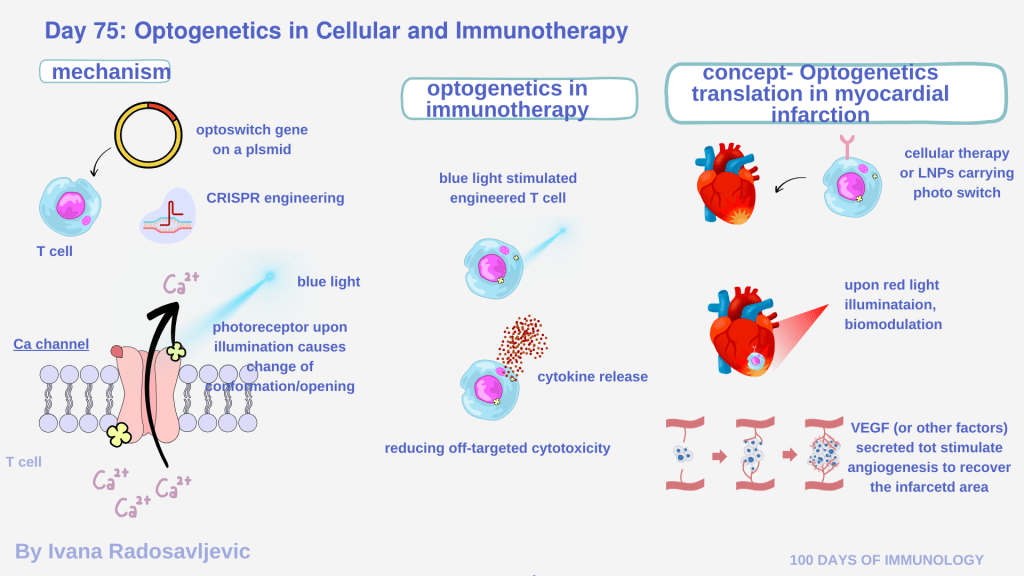
Optogenetics – genetically encoded light‑sensitive proteins (e.g., channelrhodopsins, phytochromes) into cells. Upon exposure to a specific wavelength of light, these proteins change conformation — opening ion channels, triggering calcium fluxes, or initiating signaling cascades, controlling cell behavior.
In immune cells, optogenetic circuits have been developed to modulate calcium signaling, NFAT activation, cytokine release in a light-dependent manner [1,2,3].
My Lab Anecdote and Translatioanl Imagination
During my master’s thesis, I used red‑light to induce angiogenesis post‑myocardial infarction – a concept that sounded as science‑fiction then as it does now. I imagined a future where a clinician holds a remote controller to trigger a therapeutic response in a patient, via an implantable device.
Between 09/2022 and 12/2025, my perspective matured.
Now I envision a bioresponsive cell therapy: an engineered immune (or progenitor) cell, delivered like a CAR‑cell therapy, bearing a photoreceptor domain and a targeting module. At the same time, a second agent (e.g., a sensor drug) circulates, responding to tissue injury signals (e.g., myocardial infarction) and triggering local light delivery to activate the engineered cells only at the site of pathology.
Theoretically, such a system could instruct cells to produce angiogenic factors, promoting vascular repair, while remaining silent elsewhere. But the risks of this approach are condescending: light could reach wrong tissues (e.g., brainstem, liver), potentially leading to off-target microvascular proliferation, thrombosis, or uncontrolled angiogenesis – especially in patients with comorbidities like atherosclerosis or hypercholesterolemia.
𝗘𝘃𝗶𝗱𝗲𝗻𝗰𝗲 𝗼𝗳 𝗢𝗽𝘁𝗼𝗴𝗲𝗻𝗲𝘁𝗶𝗰𝘀 𝗶𝗻 Immunotherapy
A pioneering study engineered T cells with a blue-light inducible circuit: light exposure triggered cytokine expression and enhanced cytotoxicity. In mouse models, these ´light‑activated´ T cells demonstrated potent tumor elimination while offering better control over timing and localization of immune activation, potentially reducing off-target toxicity [3].
𝗤𝘂𝗲𝘀𝘁𝗶𝗼𝗻 𝗳𝗼𝗿 𝘁𝗵𝗲 𝗔𝘂𝗱𝗶𝗲𝗻𝗰𝗲
Do you know any PI working on CAR-T/TCR-T 5th gen using optogenetics to control CRS and target solid/hematological cancer?
Stay tuned for 𝗗𝗮𝘆 𝟳𝟲: 𝗢𝗿𝗴𝗮𝗻𝗼𝗶𝗱𝘀 𝗶𝗻 𝗜𝗺𝗺𝘂𝗻𝗼𝗹𝗼𝗴𝘆 – 𝗠𝗼𝗱𝗲𝗹𝗶𝗻𝗴 𝗛𝘂𝗺𝗮𝗻 𝗜𝗺𝗺𝘂𝗻𝗶𝘁𝘆 𝗶𝗻 𝗮 𝗗𝗶𝘀𝗵
𝗥𝗲𝗳𝗲𝗿𝗲𝗻𝗰𝗲𝘀
1. DOI: 10.1016/j.biotechadv.2022.108005
2. DOI: 10.1042/EBC20253014
3. DOI: 10.7150/thno.27051
#Optogenetics #Immunotherapy #CellTherapy #LightControlledCells #CAR_T #SyntheticBiology #PrecisionMedicine #TCellEngineering #RegenerativeMedicine #ImmunoOncology #InnovativeTherapies #100DaysOfImmunology
 Ivana Radosavljević | Immunotherapy Scientist | Living and Breathing Immunology