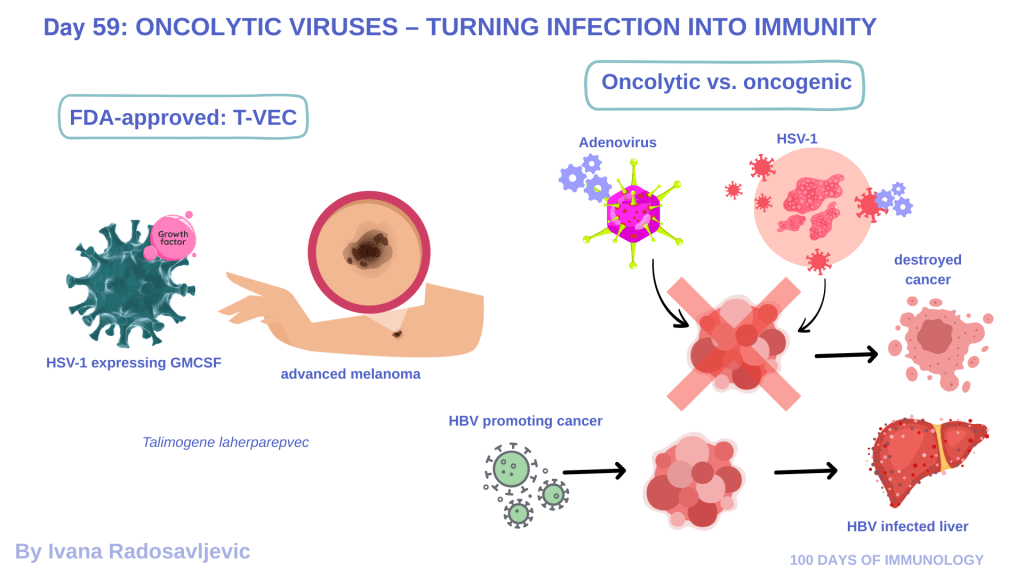
Oncolytic viruses (OVs) are genetically engineered to selectively infect, replicate within, and lyse cancer cells while sparing normal tissues. In the process, they convert the tumor into a local immune training ground, releasing danger signals and neoantigens that activate systemic anti-tumor immunity [1].
𝗙𝗗𝗔-𝗮𝗽𝗽𝗿𝗼𝘃𝗲𝗱 𝗼𝗻𝗰𝗼𝗹𝘆𝘁𝗶𝗰 𝘁𝗵𝗲𝗿𝗮𝗽𝘆
So far, only 𝘛𝘢𝘭𝘪𝘮𝘰𝘨𝘦𝘯𝘦 𝘭𝘢𝘩𝘦𝘳𝘱𝘢𝘳𝘦𝘱𝘷𝘦𝘤 (𝘛-𝘝𝘌𝘊) – a modified herpes simplex virus type-1 (HSV-1) expressing GM-CSF – has received FDA approval for the treatment of advanced melanoma [2]. T-VEC selectively replicates in tumor cells, induces immunogenic cell death, and recruits dendritic cells to prime cytotoxic T lymphocytes.
𝗢𝗻𝗰𝗼𝗹𝘆𝘁𝗶𝗰 𝘃𝘀. 𝗢𝗻𝗰𝗼𝗴𝗲𝗻𝗶𝗰 𝗩𝗶𝗿𝘂𝘀𝗲𝘀
Oncolytic viruses are engineered or naturally selected to destroy tumor cells (e.g., HSV-1, adenovirus, vaccinia, reovirus). Oncogenic viruses (like HPV, HBV, EBV) do the opposite — they promote cancer development by integrating into host DNA or driving chronic inflammation [3]. The difference lies in the intent and molecular engineering: 𝘰𝘯𝘦 𝘩𝘦𝘢𝘭𝘴 𝘣𝘺 𝘬𝘪𝘭𝘭𝘪𝘯𝘨, 𝘵𝘩𝘦 𝘰𝘵𝘩𝘦𝘳 𝘩𝘢𝘳𝘮𝘴 𝘣𝘺 𝘩𝘪𝘫𝘢𝘤𝘬𝘪𝘯𝘨.
𝗔𝗱𝘃𝗮𝗻𝘁𝗮𝗴𝗲𝘀:
• Induce direct tumor cell lysis and systemic anti-tumor immunity.
• Can be engineered to express cytokines, immune checkpoint blockers, or costimulatory ligands.
• The ´living drug´ concept.
𝗖𝗵𝗮𝗹𝗹𝗲𝗻𝗴𝗲𝘀:
• Pre-existing antiviral immunity can limit efficacy.
• Risk of systemic inflammation.
• Manufacturing complexity and biosafety regulations.
• Heterogeneous tumor microenvironment (TME) limits viral spread [4].
𝗦𝗽𝗲𝗰𝘂𝗹𝗮𝘁𝗶𝘃𝗲 𝗛𝘆𝗽𝗼𝘁𝗵𝗲𝘀𝗶𝘀
Could next-generation synthetic virotherapies integrate sensing modules — bioswitches that detect cytokine gradients or hypoxia — to control viral replication precisely within tumors? A modular, logic-gated OV [5].
𝗤𝘂𝗲𝘀𝘁𝗶𝗼𝗻 𝗳𝗼𝗿 𝘁𝗵𝗲 𝗔𝘂𝗱𝗶𝗲𝗻𝗰𝗲: Would you trust a therapy based on a genetically modified virus if it offered a chance of complete remission?
See my BioRender Template: https://app.biorender.com/biorender-templates/t-5f983b45b8682300abe9deec
Stay tuned for 𝗗𝗮𝘆 𝟲𝟬: 𝗕𝗶𝗧𝗘𝘀 – 𝗕𝗿𝗶𝗱𝗴𝗶𝗻𝗴 𝗧 𝗖𝗲𝗹𝗹𝘀 𝗮𝗻𝗱 𝗧𝘂𝗺𝗼𝗿𝘀 𝗳𝗼𝗿 𝗣𝗿𝗲𝗰𝗶𝘀𝗶𝗼𝗻 𝗜𝗺𝗺𝘂𝗻𝗼𝘁𝗵𝗲𝗿𝗮𝗽𝘆
𝗥𝗲𝗳𝗲𝗿𝗲𝗻𝗰𝗲𝘀:
1. DOI: 10.1016/j.ymthe.2017.03.026
2. DOI: 10.1200/JCO.2014.58.3377
3. DOI: 10.3390/ijms24119543
4. DOI: 10.1080/2162402X.2018.1503032
5. DOI: 10.1080/14737140.2025.2474732
#OncolyticViruses #CancerImmunology #Virotherapy #TalimogeneLaherparepvec #Immunotherapy #CancerResearch #SyntheticBiology #ImmunoOncology #TumorMicroenvironment #GMCSF #Melanoma #BioRender #PharmaScience #NextGenTherapies
 Ivana Radosavljević | Immunotherapy Scientist | Living and Breathing Immunology