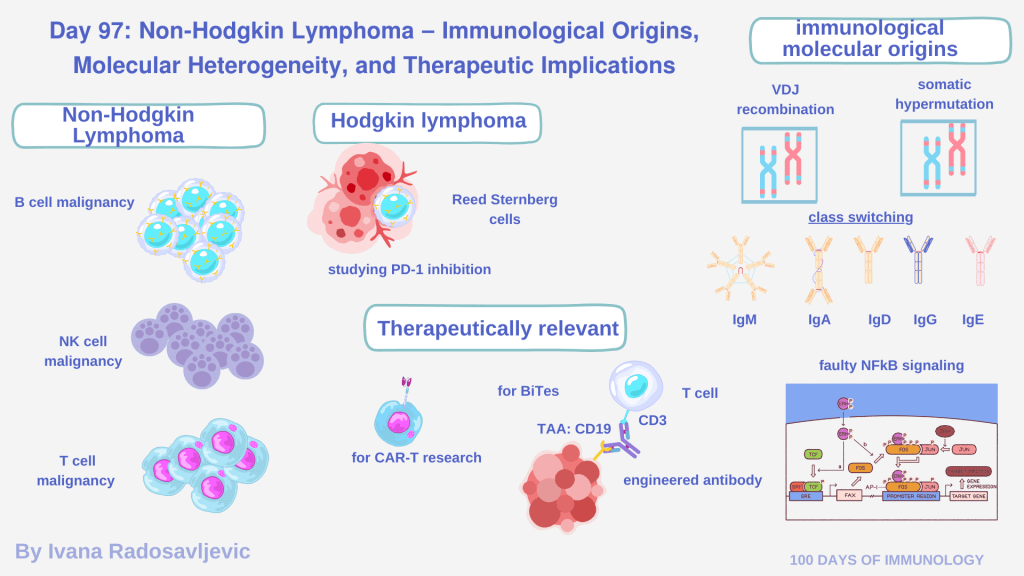
You have probably heard the terms Hodgkin lymphoma and Non-Hodgkin lymphoma countless times.
𝗡𝗼𝗻-𝗛𝗼𝗱𝗴𝗸𝗶𝗻 𝗹𝘆𝗺𝗽𝗵𝗼𝗺𝗮 (𝗡𝗛𝗟) is a large and highly heterogeneous group of malignancies arising from B cells, T cells, or NK cells at different stages of lymphocyte development [1]. In contrast to 𝗛𝗼𝗱𝗴𝗸𝗶𝗻 𝗹𝘆𝗺𝗽𝗵𝗼𝗺𝗮, which is defined by the presence of Reed–Sternberg cells and a uniform biology, NHL encompasses more than 60 distinct diseases, ranging from indolent to highly aggressive forms [1,2].
𝗜𝗺𝗺𝘂𝗻𝗼𝗹𝗼𝗴𝗶𝗰𝗮𝗹 𝗮𝗻𝗱 𝗠𝗼𝗹𝗲𝗰𝘂𝗹𝗮𝗿 𝗢𝗿𝗶𝗴𝗶𝗻𝘀
NHL reflects the normal biology of the adaptive immune system: V(D)J recombination, somatic hypermutation, and class-switch recombination are processes that generate immune diversity—but also create vulnerability to genomic instability [2]. Errors during these processes can lead to chromosomal translocations (e.g., BCL2, MYC, BCL6), aberrant signaling through the B-cell receptor, or dysregulated survival pathways such as NF-κB [3]. This explains why lymphomas are molecularly diverse even when they arise from the same lineage.
𝗛𝗲𝘁𝗲𝗿𝗼𝗴𝗲𝗻𝗲𝗶𝘁𝘆 𝗮𝘀 𝗮 𝗖𝗲𝗻𝘁𝗿𝗮𝗹 𝗖𝗵𝗮𝗹𝗹𝗲𝗻𝗴𝗲
Tumor heterogeneity in NHL exists at multiple levels:
• Between subtypes (e.g., diffuse large B-cell lymphoma vs. follicular lymphoma)
• Within the same subtype (patients with identical diagnoses can have different outcomes´)
• Within the same patient, due to clonal evolution under therapeutic pressure [3]
𝗧𝗵𝗲𝗿𝗮𝗽𝗲𝘂𝘁𝗶𝗰 𝗜𝗺𝗽𝗹𝗶𝗰𝗮𝘁𝗶𝗼𝗻𝘀
It has become a proving ground for modern immunotherapies. Monoclonal antibodies (e.g., anti-CD20), antibody–drug conjugates, BiTEs, and CAR-T cell therapies have all shown efficacy but only in selected molecular and antigen-defined contexts [4]. Antigen loss, lineage plasticity, and immune escape illustrate how tumor heterogeneity can limit powerful targeted therapies.
𝗤𝘂𝗲𝘀𝘁𝗶𝗼𝗻 𝗳𝗼𝗿 𝘁𝗵𝗲 𝗮𝘂𝗱𝗶𝗲𝗻𝗰𝗲
How far can we safely immune engineer before therapeutic itself becomes a driver of malignant evolution? (e.g. secondary lymphomas)
Stay tuned for 𝗗𝗮𝘆 𝟵𝟴: 𝗜𝗺𝗺𝘂𝗻𝗼𝗹𝗼𝗴𝘆 𝗮𝗯𝗯𝗿𝗲𝘃𝗶𝗮𝘁𝗶𝗼𝗻𝘀
𝗥𝗲𝗳𝗲𝗿𝗲𝗻𝗰𝗲𝘀
1. https://lnkd.in/ex6z9Msz
2. DOI: 10.1038/nrc1589
3. DOI: 10.1038/s41591-018-0016-8
4. DOI: 10.1056/NEJMra1706169
#Immunology #Hematology #Lymphoma #CancerBiology #Immunotherapy #CAR_T #PrecisionMedicine #TumorHeterogeneity #100DaysOfImmunology
 Ivana Radosavljević | Immunotherapy Scientist | Living and Breathing Immunology