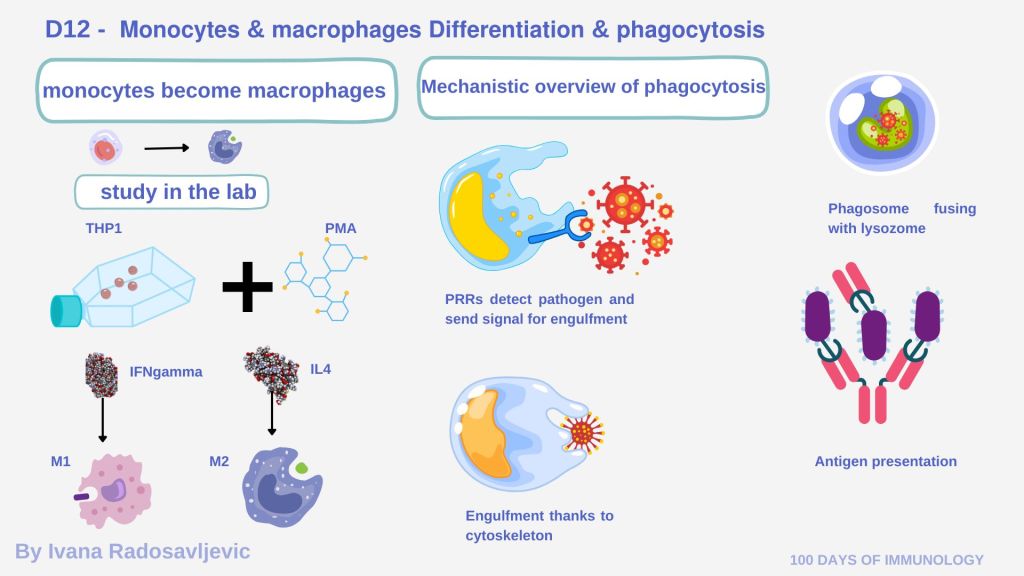
Monocytes are the body’s immigrant soldiers, patrolling the bloodstream and migrating into tissues to become macrophages—the tissue-resident soldiers.
𝗗𝗶𝗳𝗳𝗲𝗿𝗲𝗻𝘁𝗶𝗮𝘁𝗶𝗼𝗻 & 𝗣𝗼𝗹𝗮𝗿𝗶𝘇𝗮𝘁𝗶𝗼𝗻
Monocytes differentiate into macrophages upon entering tissues, influenced by cytokines and growth factors. This differentiation is crucial for their role in immune surveillance and tissue repair.
𝘔1 𝘔𝘢𝘤𝘳𝘰𝘱𝘩𝘢𝘨𝘦𝘴: Induced by IFN-γ and LPS, these are pro-inflammatory and microbicidal.
𝘔2 𝘔𝘢𝘤𝘳𝘰𝘱𝘩𝘢𝘨𝘦𝘴: Induced by IL4 and IL13, these are involved in tissue repair and resolution of inflammation.
𝘏𝘶𝘮𝘢𝘯 𝘛𝘏𝘗-1 𝘤𝘦𝘭𝘭𝘴 are a widely used in vitro model:
Differentiation via PMA → macrophage-like cells
Polarization → M1 or M2 using cytokine cocktails
𝗠𝗲𝗰𝗵𝗮𝗻𝗶𝘀𝘁𝗶𝗰 𝗢𝘃𝗲𝗿𝘃𝗶𝗲𝘄 𝗼𝗳 𝗣𝗵𝗮𝗴𝗼𝗰𝘆𝘁𝗼𝘀𝗶𝘀
Phagocytosis is a regulated, multi-step process:
𝘙𝘦𝘤𝘰𝘨𝘯𝘪𝘵𝘪𝘰𝘯 → PRRs (TLRs, mannose receptor) or opsonin receptors (FcγR, complement) detect pathogens or apoptotic cells. “Eat me” signals such as phosphatidylserine trigger engulfment.
𝘌𝘯𝘨𝘶𝘭𝘧𝘮𝘦𝘯𝘵 → Cytoskeletal remodeling forms the phagocytic cup, enclosing the target into a phagosome.
𝘔𝘢𝘵𝘶𝘳𝘢𝘵𝘪𝘰𝘯 & 𝘒𝘪𝘭𝘭𝘪𝘯𝘨 → Phagosome fuses with lysosome → phagolysosome. Acidification, enzymes, and ROS/RNS degrade the cargo.
𝘈𝘯𝘵𝘪𝘨𝘦𝘯 𝘗𝘳𝘦𝘴𝘦𝘯𝘵𝘢𝘵𝘪𝘰𝘯 → Pathogen peptides can be loaded on MHC class II molecules to activate T cells.
𝗚𝗲𝗿𝗺𝗮𝗻 𝗖𝗼𝗻𝘁𝗿𝗶𝗯𝘂𝘁𝗶𝗼𝗻𝘀
Markus Feuerer (University of Regensburg): Monocytes develop from committed progenitors (cMoP) distinct from dendritic cell progenitors [1].
Jürgen Sander (University of Freiburg): Transcriptional regulation of monocyte differentiation and macrophage polarization [2].
Stefan Kaufmann (MPI Berlin): Insights into phagocytosis and antimicrobial responses in macrophages [3].
𝗠𝗮𝗰𝗿𝗼𝗽𝗵𝗮𝗴𝗲𝘀 𝗶𝗻 𝗖𝗮𝗿𝗱𝗶𝗼𝘃𝗮𝘀𝗰𝘂𝗹𝗮𝗿 𝗖𝗼𝗻𝘁𝗲𝘅𝘁
Myocardial Infarction: Macrophages clear dead cells, promote healing, but excessive inflammation can lead to fibrosis.
Atherosclerosis: Macrophages ingest oxidized LDL → foam cells → plaque formation.
Speculative hypothesis: Could engineered macrophages with enhanced phagocytic capacity serve as CAR-M therapies targeting tumor cells or atherosclerotic plaques?
Stay tuned for 𝗗𝗮𝘆 𝟭𝟯: 𝗗𝗲𝗻𝗱𝗿𝗶𝘁𝗶𝗰 𝗰𝗲𝗹𝗹𝘀 – 𝗮𝗻𝘁𝗶𝗴𝗲𝗻 𝗽𝗿𝗲𝘀𝗲𝗻𝘁𝗮𝘁𝗶𝗼𝗻
𝗥𝗲𝗳𝗲𝗿𝗲𝗻𝗰𝗲𝘀
1. DOI: 10.1038/ni.2638
2. doi: 10.1016/j.immuni.2017.11.024
3. DOI: 10.1016/j.immuni.2016.02.014
#100DaysOfImmunology #Monocytes #Macrophages #Phagocytosis #Differentiation #CardiovascularResearch #MacrophagePolarization #GermanImmunology #THP1Cells #ImmunologyResearch #CARMacrophages
 Ivana Radosavljević | Immunotherapy Scientist | Living and Breathing Immunology