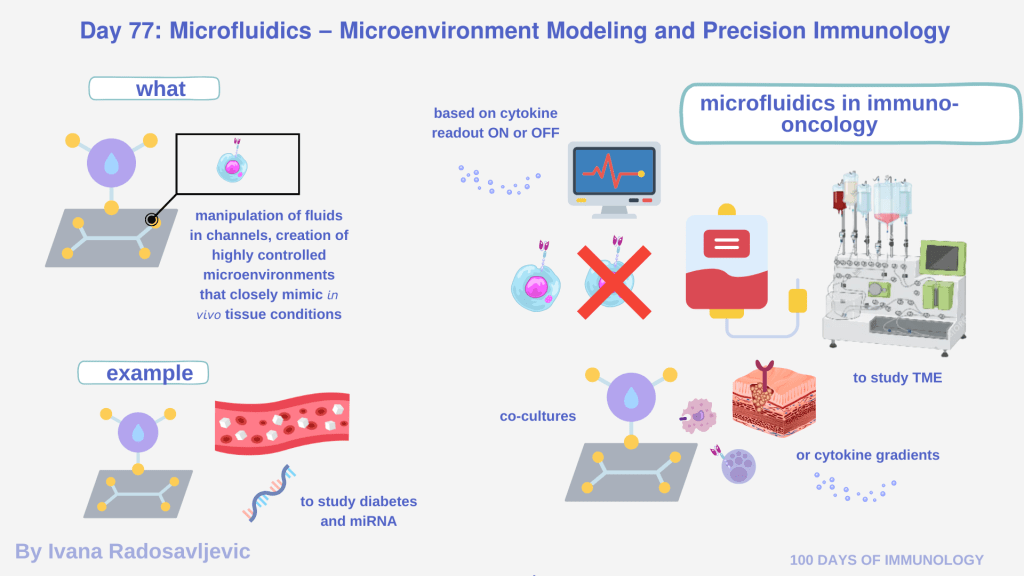
Microfluidics is the precise manipulation of fluids in channels at the microliter/nanoliter scale, enabling the creation of highly controlled microenvironments that closely mimic in vivo tissue conditions [1].
My first exposure to this technology was during my master’s in cardiovascular research, where a PhD student used a microfluidic system to culture HUVECs and study diabetes-associated miRNA signaling. I was fascinated by the intricate network of valves and channels, which now reminds me of closed-system T cell isolation platforms like CliniMACS or linking a Leukopak to the Lonza Cocoon system – both of which rely on similarly precise fluid handling to optimize cell therapy manufacturing.
Immuno-oncology
In immuno-oncology, microfluidic platforms are now increasingly used to model the tumor microenvironment (TME), allowing co-culture of tumor spheroids with immune cells such as CAR-T, NK, or macrophages under physiologically relevant flow conditions [2,3]. These systems enable the study of immune cell infiltration, cytokine gradients, and immune checkpoint interactions in a controlled, reproducible manner. They also facilitate high-throughput testing of combination therapies.
Beyond preclinical modeling, microfluidics has the potential to integrate with biosensors and dynamic drug delivery systems. For example, one could imagine a platform that senses cytokine levels in real time and modulates CAR-T activation or drug release in situ—essentially creating a closed-loop precision immunotherapy system.
𝗦𝗽𝗲𝗰𝘂𝗹𝗮𝘁𝗶𝘃𝗲 𝗵𝘆𝗽𝗼𝘁𝗵𝗲𝘀𝗶𝘀: Could microfluidic systems be engineered to test novel immunotherapies? Allowing fully personalized testing of CAR-T, BiTEs, or NK therapies before clinical administration?
𝗤𝘂𝗲𝘀𝘁𝗶𝗼𝗻 𝗳𝗼r 𝘁𝗵𝗲 𝗮𝘂𝗱𝗶𝗲𝗻𝗰𝗲: How far do you think microfluidic platforms can replace animal models in immuno-oncology research, and what limitations do you foresee in scaling these systems for routine drug testing?
Stay tuned for 𝗗𝗮𝘆 𝟳𝟴: 𝗖𝘆𝗧𝗢𝗙 – 𝗠𝗮𝘀𝘀 Spectrometry for 𝗛𝗶𝗴𝗵-𝗗𝗶𝗺𝗲𝗻𝘀𝗶𝗼𝗻𝗮𝗹 𝗜𝗺𝗺𝘂𝗻𝗲 𝗣𝗿𝗼𝗳𝗶𝗹𝗶𝗻𝗴
𝗥𝗲𝗳𝗲𝗿𝗲𝗻𝗰𝗲𝘀:
1. DOI: 10.1038/nature13118
2. DOI: 10.1038/s41578-018-0034-7
3. DOI: 10.1039/D0LC01305F
#Microfluidics #ImmunoOncology #CART #TumorMicroenvironment #PrecisionMedicine #CellTherapy #LabOnAChip #100DaysofImmunology
 Ivana Radosavljević | Immunotherapy Scientist | Living and Breathing Immunology