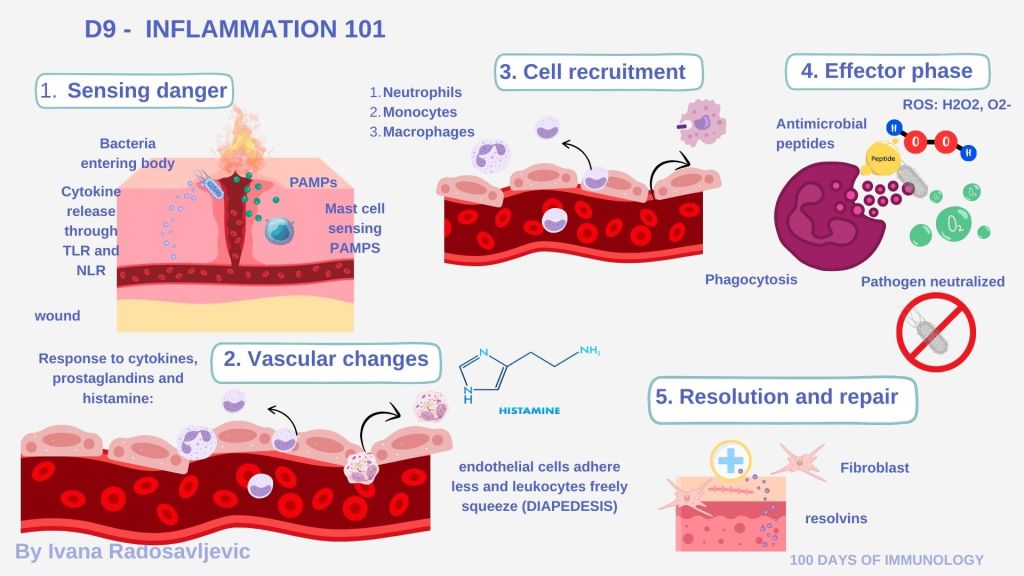
Inflammation is often described as the ´fire´ of the immune system — protective when controlled, destructive when unchecked. It removes harmful stimuli, initiates repair, and restores homeostasis. But mechanistically, what actually happens during inflammation?
𝗦𝘁𝗲𝗽𝘄𝗶𝘀𝗲 𝗠𝗲𝗰𝗵𝗮𝗻𝗶𝘀𝗺𝘀 𝗼𝗳 𝗜𝗻𝗳𝗹𝗮𝗺𝗺𝗮𝘁𝗶𝗼𝗻
𝗦𝗲𝗻𝘀𝗶𝗻𝗴 𝗱𝗮𝗻𝗴𝗲𝗿
Tissue-resident macrophages, dendritic cells, and mast cells detect 𝘱𝘢𝘵𝘩𝘰𝘨𝘦𝘯𝘴 (𝘷𝘪𝘢 𝘗𝘈𝘔𝘗𝘴) 𝘰𝘳 𝘤𝘦𝘭𝘭 𝘥𝘢𝘮𝘢𝘨𝘦 (𝘷𝘪𝘢 𝘋𝘈𝘔𝘗𝘴).
𝘗𝘢𝘵𝘵𝘦𝘳𝘯-𝘳𝘦𝘤𝘰𝘨𝘯𝘪𝘵𝘪𝘰𝘯 𝘳𝘦𝘤𝘦𝘱𝘵𝘰𝘳𝘴 (𝘗𝘙𝘙𝘴), such as TLRs and NLRs, trigger intracellular signaling and cytokine release [1].
𝗩𝗮𝘀𝗰𝘂𝗹𝗮𝗿 𝗰𝗵𝗮𝗻𝗴𝗲𝘀
Histamine, prostaglandins, and cytokines increase 𝘷𝘢𝘴𝘤𝘶𝘭𝘢𝘳 𝘱𝘦𝘳𝘮𝘦𝘢𝘣𝘪𝘭𝘪𝘵𝘺. Endothelial cells express adhesion molecules, allowing leukocytes to squeeze through vessel walls (𝘥𝘪𝘢𝘱𝘦𝘥𝘦𝘴𝘪𝘴) [1,2].
𝗖𝗲𝗹𝗹 𝗿𝗲𝗰𝗿𝘂𝗶𝘁𝗺𝗲𝗻𝘁
Neutrophils are first responders, followed by monocytes/macrophages and lymphocytes. 𝘊𝘩𝘦𝘮𝘰𝘬𝘪𝘯𝘦𝘴 𝘤𝘳𝘦𝘢𝘵𝘦 𝘨𝘳𝘢𝘥𝘪𝘦𝘯𝘵𝘴 that guide cells to the site of injury [2].
𝗘𝗳𝗳𝗲𝗰𝘁𝗼𝗿 𝗽𝗵𝗮𝘀𝗲
Phagocytosis, reactive oxygen species (ROS), antimicrobial peptides, and cytokines eliminate the trigger.
𝗥𝗲𝘀𝗼𝗹𝘂𝘁𝗶𝗼𝗻 𝗮𝗻𝗱 𝗿𝗲𝗽𝗮𝗶𝗿
Specialized 𝘱𝘳𝘰𝘳𝘦𝘴𝘰𝘭𝘷𝘪𝘯𝘨 𝘮𝘦𝘥𝘪𝘢𝘵𝘰𝘳𝘴 (𝘚𝘗𝘔𝘴), 𝘴𝘶𝘤𝘩 𝘢𝘴 𝘳𝘦𝘴𝘰𝘭𝘷𝘪𝘯𝘴 𝘢𝘯𝘥 𝘭𝘪𝘱𝘰𝘹𝘪𝘯𝘴, 𝘢𝘤𝘵𝘪𝘷𝘦𝘭𝘺 𝘵𝘶𝘳𝘯 𝘰𝘧𝘧 𝘪𝘯𝘧lammation.
Fibroblasts and epithelial cells initiate tissue repair. Failure here leads to chronic inflammation [3].
𝗚𝗲𝗿𝗺𝗮𝗻 𝗖𝗼𝗻𝘁𝗿𝗶𝗯𝘂𝘁𝗶𝗼𝗻𝘀
Thomas Blankenstein (Charité Berlin): Pioneered research on cytokine-driven inflammation in cancer immunology and T cell regulation [4].
Jürgen Ruland (Technical University of Munich): Studies intracellular signaling pathways (e.g., NF-κB, CARD9) that orchestrate inflammatory responses [5].
Michaela Frye (Leibniz Institute on Aging, Jena): Investigates RNA modifications and how they shape inflammatory gene expression and tissue regeneration [6].
𝗙𝗮𝘀𝗰𝗶𝗻𝗮𝘁𝗶𝗼𝗻 & 𝗦𝗽𝗲𝗰𝘂𝗹𝗮𝘁𝗶𝗼𝗻
Speculative hypothesis: Could targeting targeting these ´resolution checkpoints´ (e.g.NF-κB pathways) might prevent chronic inflammatory disease before it manifests clinically?
Stay tuned for 𝗗𝗮𝘆 𝟭𝟬: 𝗛𝗼𝘄 𝘄𝗲 𝘀𝘁𝘂𝗱𝘆 𝗶𝗺𝗺𝘂𝗻𝗼𝗹𝗼𝗴𝘆 𝗶𝗻 𝗹𝗮𝗯𝘀
𝗥𝗲𝗳𝗲𝗿𝗲𝗻𝗰𝗲𝘀
1. DOI: 10.1016/j.cell.2010.03.006
2. DOI: 10.1038/nature01320
3. DOI: 10.1038/nri2294
4. DOI: 10.1016/j.molmed.2005.03.002
5. DOI: 10.1196/annals.1443.024
6. DOI: 10.1038/s41556-019-0319-0
#100DaysOfImmunology #Inflammation #InnateImmunity #ChronicInflammation #Resolution #MechanisticImmunology #GermanResearch #ScienceCommunication #TeachingImmunology #Autoimmunity
 Ivana Radosavljević | Immunotherapy Scientist | Living and Breathing Immunology