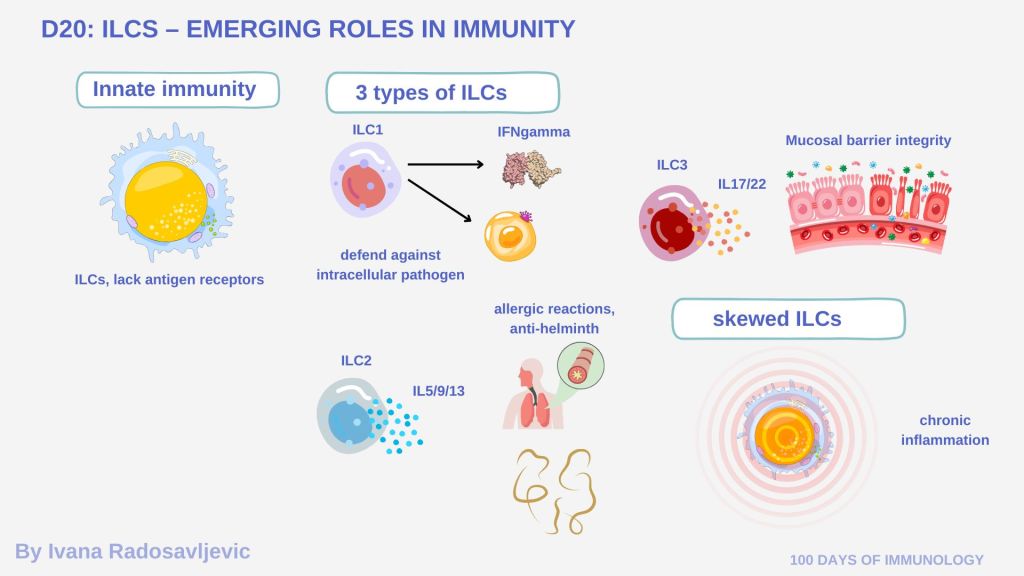
Innate lymphoid cells (ILCs) are a recently characterised family of lymphoid-lineage immune cells that lack antigen-specific receptors, yet contribute to host defence, tissue homeostasis, inflammation, repair, and metabolic regulation. They are part of the 𝘪𝘯𝘯𝘢𝘵𝘦 𝘪𝘮𝘮𝘶𝘯𝘦 𝘤𝘰𝘮𝘱𝘢𝘳𝘵𝘮𝘦𝘯𝘵 but show 𝘧𝘶𝘯𝘤𝘵𝘪𝘰𝘯𝘢𝘭 𝘱𝘢𝘳𝘢𝘭𝘭𝘦𝘭𝘴 𝘸𝘪𝘵𝘩 𝘢𝘥𝘢𝘱𝘵𝘪𝘷𝘦 𝘛 𝘩𝘦𝘭𝘱𝘦𝘳 𝘢𝘯𝘥 𝘤𝘺𝘵𝘰𝘵𝘰𝘹𝘪𝘤 𝘤𝘦𝘭𝘭 𝘴𝘶𝘣𝘴𝘦𝘵𝘴 [1,2].
𝗧𝘆𝗽𝗲𝘀 𝗼𝗳 𝗜𝗟𝗖𝘀 𝗮𝗻𝗱 𝗧𝗵𝗲𝗶𝗿 𝗖𝗵𝗮𝗿𝗮𝗰𝘁𝗲𝗿𝗶𝘀𝘁𝗶𝗰𝘀
There are three major ´helper-like´ non-cytotoxic ILC groups (excluding NK cells and LTi):
𝘐𝘓𝘊1: Produce type 1 cytokines such as IFN-γ; transcription factor T-bet is critical. They mirror Th1 cells and defend against intracellular pathogens [2].
𝘐𝘓𝘊2: Depend on GATA-3; secrete IL-5, IL-9, IL-13; important in anti-helminth responses, allergic inflammation, and barrier repair [2,3].
𝘐𝘓𝘊3: Depend on RORγt; produce IL-17 and IL-22; include lymphoid tissue inducer (LTi) cells; key in mucosal barrier integrity and microbiota regulation [2,4].
𝗗𝗶𝘀𝗰𝗼𝘃𝗲𝗿𝘆 𝗧𝗶𝗺𝗲𝗹𝗶𝗻𝗲
In the early 2010s, groups reported non-T, non-B lymphoid cells with helper-like roles. ILC2s were first described in allergy and parasitic settings around 2009–2011. A classification into ILC1, ILC2, and ILC3 was proposed in 2013 [1,2]. NK cells and LTi cells had been known earlier but were later incorporated into the broader ILC family [2].
𝗚𝗲𝗿𝗺𝗮𝗻 𝗥𝗲𝘀𝗲𝗮𝗿𝗰𝗵𝗲𝗿𝘀
Laura Surace (University of Bonn) investigates immunometabolism in ILCs, showing how PD-1 functions as a metabolic checkpoint and how distinct metabolic networks govern ILC2 proliferation and function [3].
Christoph Wilhelm (University of Bonn) leads research on barrier immunity, demonstrating how environmental and nutritional cues regulate protective versus pathogenic ILC responses. His work revealed how lipid metabolism drives pathogenic ILC2s in airway inflammation [4].
𝗦𝗽𝗲𝗰𝘂𝗹𝗮𝘁𝗶𝘃𝗲 𝗛𝘆𝗽𝗼𝘁𝗵𝗲𝘀𝗶𝘀: 𝗜𝗟𝗖𝘀 𝗮𝘀 ´𝗠𝗲𝘁𝗮𝗯𝗼𝗹𝗶𝗰 𝗚𝗮𝘁𝗲𝗸𝗲𝗲𝗽𝗲𝗿𝘀´
ILCs may act as metabolic gatekeepers of barrier immunity. In modern lifestyles, skewed metabolic input may shift ILCs from protective to pathogenic states, promoting chronic inflammation and allergy. Interventions that reset ILC metabolic programming could represent a novel preventive or therapeutic avenue.
Stay tuned for 𝗗𝗮𝘆 𝟮𝟭: 𝗘𝗼𝘀𝗶𝗻𝗼𝗽𝗵𝗶𝗹𝘀 – 𝗔𝗹𝗹𝗲𝗿𝗴𝗶𝗲𝘀 & 𝗣𝗮𝗿𝗮𝘀𝗶𝘁𝗲𝘀
𝗥𝗲𝗳𝗲𝗿𝗲𝗻𝗰𝗲𝘀
1. DOI: 10.1016/j.cell.2018.07.017
2. DOI: 10.1038/nature14189
3. DOI: 10.1038/s41590-021-01043-8
4. DOI: 10.1016/j.immuni.2020.03.003
#100DaysOfImmunology #ILCs #InnateLymphoidCells #BarrierImmunity #Immunometabolism #ILC1 #ILC2 #ILC3 #GermanResearchers #Allergy #ChronicInflammation #ImmunologyResearch
 Ivana Radosavljević | Immunotherapy Scientist | Living and Breathing Immunology