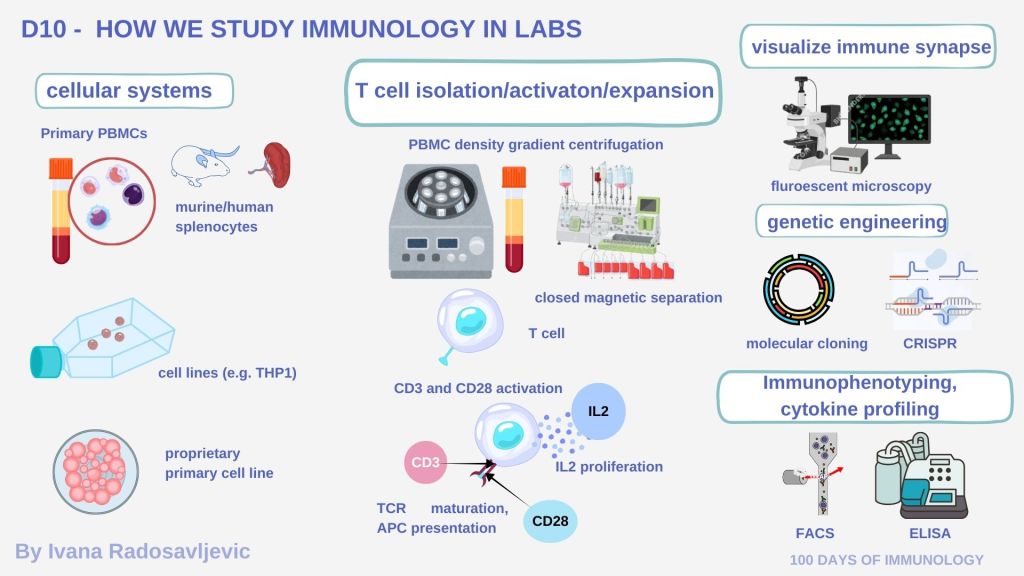
Each assay answers a different ´what, who, how´ question.
𝗖𝗲𝗹𝗹𝘂𝗹𝗮𝗿 𝗦𝘆𝘀𝘁𝗲𝗺𝘀 — 𝘁𝗵𝗲 𝗣𝗹𝗮𝘆𝗴𝗿𝗼𝘂𝗻𝗱 𝗼𝗳 𝗜𝗺𝗺𝘂𝗻𝗼𝗹𝗼𝗴𝘆
𝘗𝘳𝘪𝘮𝘢𝘳𝘺 𝘤𝘦𝘭𝘭𝘴 are freshly isolated from human or murine donors [1] (PBMCs, splenocytes). They are physiologically relevant but have limited lifespan.
𝘐𝘮𝘮𝘰𝘳𝘵𝘢𝘭𝘪𝘻𝘦𝘥 𝘤𝘦𝘭𝘭 𝘭𝘪𝘯𝘦𝘴 (e.g., Jurkat, THP-1, Raji) can proliferate indefinitely, offering reproducibility but often lacking full physiological context.
𝘗𝘳𝘰𝘱𝘳𝘪𝘦𝘵𝘢𝘳𝘺 𝘱𝘳𝘪𝘮𝘢𝘳𝘺-𝘭𝘪𝘬𝘦 𝘤𝘦𝘭𝘭𝘴 exist in some labs as donor-derived or specially engineered lines; these are finite, specialized, and restricted to certain labs.
𝗧 𝗰𝗲𝗹𝗹 𝗶𝘀𝗼𝗹𝗮𝘁𝗶𝗼𝗻, 𝗮𝗰𝘁𝗶𝘃𝗮𝘁𝗶𝗼𝗻, 𝗮𝗻𝗱 𝗲𝘅𝗽𝗮𝗻𝘀𝗶𝗼𝗻 – 𝗮 𝗰𝗼𝗿𝗻𝗲𝗿𝘀𝘁𝗼𝗻𝗲 𝗼𝗳 𝗶𝗺𝗺𝘂𝗻𝗼𝗹𝗼𝗴𝘆:
𝘐𝘴𝘰𝘭𝘢𝘵𝘪𝘰𝘯: PBMCs are obtained via density gradient centrifugation (buffy coat), or from leukapheresis with T cells enriched using magnetic separation (MACS) kits, or MACS separation in closed systems.
𝘈𝘤𝘵𝘪𝘷𝘢𝘵𝘪𝘰𝘯: Engagement of CD3 and CD28 mimics antigen presentation and triggers T cell receptor signaling.
𝘌𝘹𝘱𝘢𝘯𝘴𝘪𝘰𝘯: Cytokines like IL-2 drive proliferation for functional assays or co-culture experiments.
𝗙𝘂𝗻𝗰𝘁𝗶𝗼𝗻𝗮𝗹 & 𝗠𝗼𝗹𝗲𝗰𝘂𝗹𝗮𝗿 𝗥𝗲𝗮𝗱𝗼𝘂𝘁𝘀
𝘍𝘭𝘰𝘸 𝘤𝘺𝘵𝘰𝘮𝘦𝘵𝘳𝘺 & 𝘴𝘰𝘳𝘵𝘪𝘯𝘨 → high-dimensional immunophenotyping, cytokine detection, and differentiation analysis.
𝘌𝘓𝘐𝘚𝘈 & 𝘮𝘶𝘭𝘵𝘪𝘱𝘭𝘦𝘹 𝘢𝘴𝘴𝘢𝘺𝘴 → quantify secreted cytokines and immune signaling cascades. [2]
𝘔𝘪𝘤𝘳𝘰𝘴𝘤𝘰𝘱𝘺 → visualize immune synapses, migration, vesicle secretion; mucus secretion assays could potentially be adapted to extracellular vesicles (EVs) in immunology.
𝘲𝘗𝘊𝘙 & 𝘞𝘦𝘴𝘵𝘦𝘳𝘯 𝘣𝘭𝘰𝘵 → measure transcriptional and protein-level changes.
𝘔𝘰𝘭𝘦𝘤𝘶𝘭𝘢𝘳 𝘤𝘭𝘰𝘯𝘪𝘯𝘨 & 𝘊𝘙𝘐𝘚𝘗𝘙 𝘦𝘯𝘨𝘪𝘯𝘦𝘦𝘳𝘪𝘯𝘨 → manipulate signaling pathways or create synthetic circuits.
𝘚𝘪𝘯𝘨𝘭𝘦-𝘤𝘦𝘭𝘭 𝘙𝘕𝘈 𝘴𝘦𝘲𝘶𝘦𝘯𝘤𝘪𝘯𝘨 → dissect heterogeneity and spatial organization in tissues. [3]
𝗦𝗽𝗲𝗰𝘂𝗹𝗮𝘁𝗶𝘃𝗲 𝗵𝘆𝗽𝗼𝘁𝗵𝗲𝘀𝗶𝘀: Mastering T cell engineering and primary culture opens the door to designing modular CAR-T cells, like LEGO blocks: interchangeable activation, cytokine, and safety modules, potentially monitored through EV secretion. This could allow personalized, tunable immune therapies where each patient’s CAR-T is optimized for both efficacy and safety.
Stay tuned for 𝗗𝗮𝘆 𝟭𝟭: 𝗡𝗲𝘂𝘁𝗿𝗼𝗽𝗵𝗶𝗹𝘀: 𝗿𝗮𝗽𝗶𝗱 𝗿𝗲𝘀𝗽𝗼𝗻𝗱𝗲𝗿𝘀
𝗥𝗲𝗳𝗲𝗿𝗲𝗻𝗰𝗲𝘀
1. DOI: 10.1038/nri2017
2. DOI: 10.1016/s0022-1759(97)00030-6
3. DOI: 10.1038/nri.2017.76
#100DaysOfImmunology #ImmunologyMethods #FlowCytometry #CytokineProfiling #CellCulture #MolecularImmunology #TCellEngineering #ImmunoImaging #CARTCells #SyntheticImmunology #ScienceCommunication #TeachingImmunology
 Ivana Radosavljević | Immunotherapy Scientist | Living and Breathing Immunology