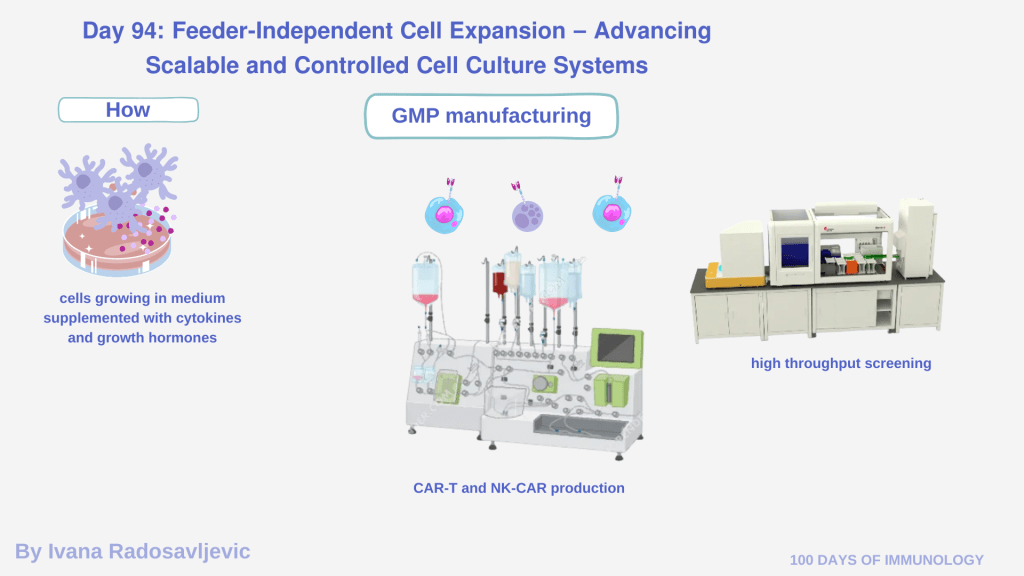
Feeder-independent cell expansion allows immune cells, stem cells, or other specialized populations to grow without the need for supportive feeder layers. This is achieved through optimized culture media supplemented with cytokines, growth factors, and extracellular matrix components that mimic the signals normally provided by feeder cells. Techniques such as chemically defined media, 3D scaffolds, and microcarrier systems further support proliferation while maintaining cell phenotype and functionality [1,2].
𝗜𝗻 𝗶𝗺𝗺𝘂𝗻𝗼𝗹𝗼𝗴𝘆, feeder-independent expansion is critical for scalable manufacturing of CAR-T cells, NK cells, and other adoptive cell therapies. It ensures reproducibility, reduces variability, and streamlines compliance with GMP standards for clinical applications [3].
This approach is especially useful for high-throughput screening, studying immune cell interactions, and generating sufficient cell numbers for preclinical or clinical studies without relying on animal-derived feeder layers.
𝗤𝘂𝗲𝘀𝘁𝗶𝗼𝗻 𝗳𝗼𝗿 𝘁𝗵𝗲 𝗮𝘂𝗱𝗶𝗲𝗻𝗰𝗲: Do you rely on feeder-independent system or using feeder cells?
Stay tuned for 𝗗𝗮𝘆 𝟵𝟱: T 𝗰𝗲𝗹𝗹 𝗲𝘅𝗵𝗮𝘂𝘀𝘁𝗶𝗼𝗻 𝘃𝘀 𝘀𝗲𝗻𝗲𝘀𝗰𝗲𝗻𝗰𝗲
𝗥𝗲𝗳𝗲𝗿𝗲𝗻𝗰𝗲𝘀:
1. DOI: 10.1186/s13578-020-00438-8
2. DOI: 10.1186/s12929-024-00994-y
3. https://lnkd.in/ewjRsvai
#Immunology #CellTherapy #CAR-T #FeederIndependent #AdoptiveCellTherapy #CellCulture #Biotech #GMP #StemCells #HighThroughput #100DaysofImmunology
 Ivana Radosavljević | Immunotherapy Scientist | Living and Breathing Immunology