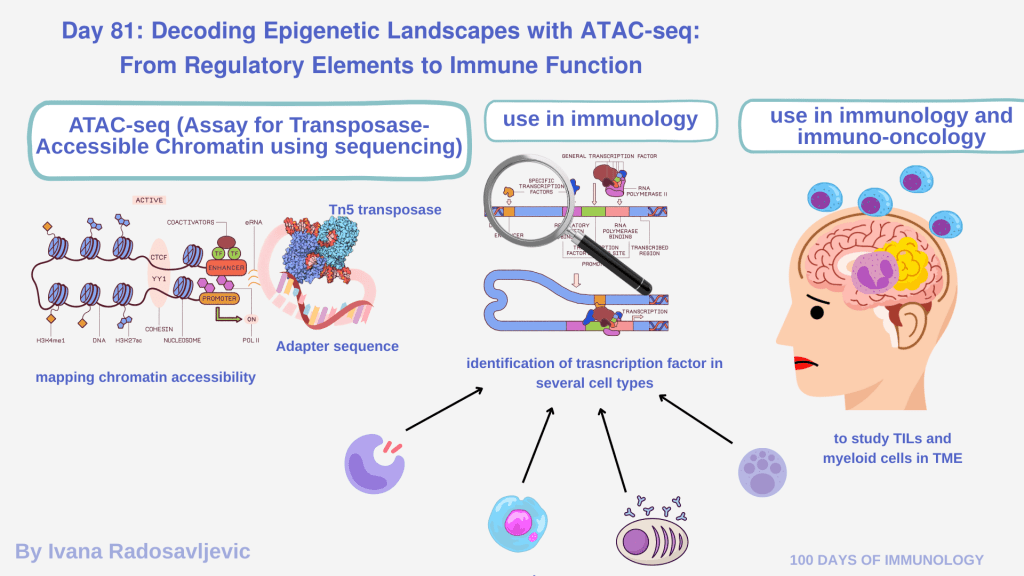
ATAC-seq (Assay for Transposase-Accessible Chromatin using sequencing) is a technique for mapping chromatin accessibility genome-wide [1]. By leveraging a hyperactive Tn5 transposase, ATAC-seq inserts sequencing adapters into regions of open chromatin, allowing researchers to identify regulatory elements such as promoters, enhancers, and insulators. This provides a detailed view of the epigenetic mechanisms controlling gene expression in specific cell types.
𝗜𝗻 𝗶𝗺𝗺uno𝗹𝗼𝗴𝘆, ATAC-seq is invaluable for dissecting the regulatory landscapes of several immune cells, including T cells, B cells, NK cells, and macrophages. It enables identification of transcription factors that regulate differentiation, activation, exhaustion, or plasticity [2].
In Immuno-Oncology, ATAC-seq is applied to study tumor-infiltrating lymphocytes (TILs) and myeloid populations within the tumor microenvironment, uncovering epigenetic mechanisms that contribute to immune evasion, resistance to therapy, or immunosuppression [3]. Integrating ATAC-seq with single-cell RNA sequencing (scATAC-seq) further allows mapping of heterogeneity in immune populations, revealing rare or transitional states that could be therapeutically targeted.
German Research:
Prof. Wolfgang Huber (EMBL, Heidelberg) integrate ATAC-seq data to understand immune cell identity, differentiation trajectories, and tumor-immune interactions [4]. Critical for designing next-generation immunotherapies that consider both the epigenetic state and functional capacity of immune cells.
𝗤𝘂𝗲𝘀𝘁𝗶𝗼𝗻 𝗳𝗼𝗿 𝘁𝗵𝗲 audience: How could integrating ATAC-seq with single-cell RNA-seq reshape our understanding of immune cell plasticity for immunotherapy in solid tumors?
Stay tuned for D𝗮𝘆 82: Translating Methods to Immunology Research Questions
𝗥𝗲𝗳𝗲𝗿𝗲𝗻𝗰𝗲𝘀:
1. DOI: 10.1038/nmeth.2688
2. DOI: 10.1038/ng.3646
3. DOI: 10.1038/s41587-019-0206-z
4. DOI: 10.1038/s41586-019-1338-5
#ATACseq #Epigenetics #Immunology #ImmunoOncology #ChromatinAccessibility #SingleCellOmics #TumorMicroenvironment #PrecisionImmunotherapy #100DaysofImmunology
 Ivana Radosavljević | Immunotherapy Scientist | Living and Breathing Immunology