CRISPR–Cas technologies have become a transformative tool in immunology. In the context of CAR‑T cell therapy, CRISPR is used also to knock out inhibitory genes, enhance persistence, and reprogram cell function [1,4].
Mechanistic Overview
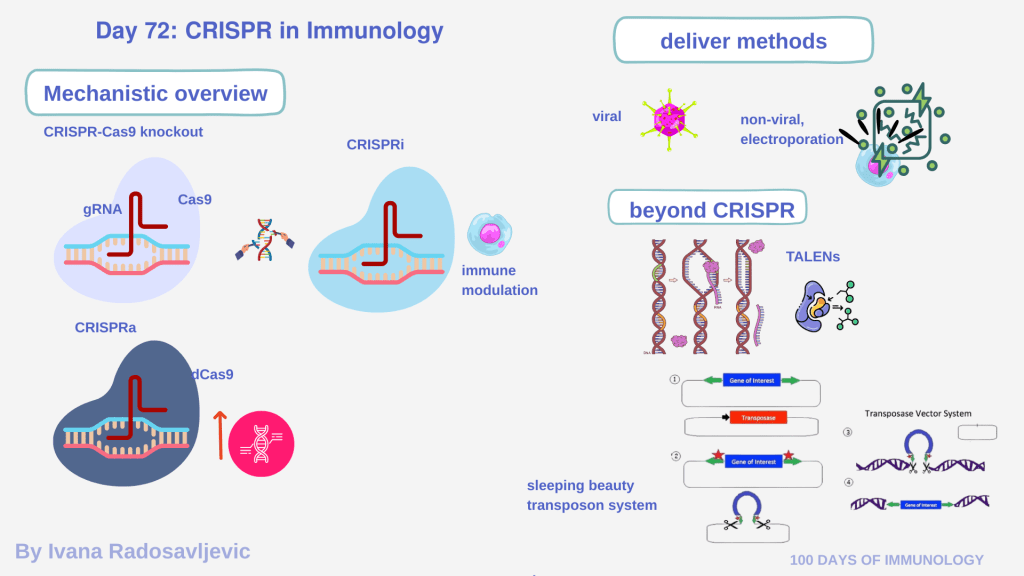
• 𝘊𝘙𝘐𝘚𝘗𝘙-𝘊𝘢𝘴9 𝘒𝘯𝘰𝘤𝘬𝘰𝘶𝘵: The canonical CRISPR system uses Cas9 to introduce double-strand breaks, allowing for knockout of genes that negatively regulate T-cell fitness [1].
• CRISPRa (CRISPR activation): Fusion of catalytically dead Cas9 (dCas9) to transcriptional activators enables upregulation of endogenous genes, such as cytokines or transcription factors, to enhance T-cell potency or persistence [4].
• 𝘊𝘙𝘐𝘚𝘗𝘙𝘪 (𝘊𝘙𝘐𝘚𝘗𝘙 interference): dCas9 fused to repressor domains can silence genes without altering the genome, useful for reversible modulation of immune function [4].
Delivery and Engineering Methods
CRISPR editing can be delivered via:
• Viral vectors (lentivirus, AAV) [1]
• Non-viral methods such as nucleofection/electroporation of Cas9 ribonucleoprotein (RNP) complexes, which reduce off-target effects and avoid viral integration [1].
Beyond CRISPR: Other Genetic Engineering Tools
Alternative editing systems:
• TALENs: site-specific nucleases with high specificity and fewer off-target risks [1].
• Sleeping Beauty transposon system: non-viral, ´cut-and-paste´ DNA integration, useful for stable, long-term expression of CARs in T cells [3].
𝗚𝗲𝗿𝗺𝗮𝗻 𝗥𝗲𝘀𝗲𝗮𝗿𝗰𝗵 𝗛𝗶𝗴𝗵𝗹𝗶𝗴𝗵𝘁𝘀
Franziska Blaeschke at DKFZ Heidelberg uses CRISPR screening to identify genetic modifications that enhance CAR-T cell fitness and function [4].
Dr. Karl Petri at the University Hospital Würzburg (UKW) is pioneering CRISPR prime editing to generate safer, precisely edited CAR-T cells [2].
The CAR FACTORY consortium in Germany combines CRISPR/Cas9 editing with virus-free engineering to improve T-cell traits such as longevity, tumor infiltration, and resistance to immunosuppression [3].
𝗤𝘂𝗲𝘀𝘁𝗶𝗼𝗻 𝗳𝗼𝗿 𝘁𝗵𝗲 𝗔𝘂𝗱𝗶𝗲𝗻𝗰𝗲
Which CRISPR-based strategy do you believe holds the most promise for next-generation CAR therapies?
Stay tuned for Day 73: Synthetic Biology beyond CAR-Ts: Mechanistic Principles
𝗥𝗲𝗳𝗲𝗿𝗲𝗻𝗰𝗲𝘀
1. https://lnkd.in/e2ngxx8q
2. https://lnkd.in/eDdfiJCz
3. https://lnkd.in/efQmmtAY
4. DOI: 10.1126/science.abj4008
#CRISPR #Immunology #CAR_T #GenomeEditing #CellTherapy #SyntheticBiology #PrimeEditing #TransposonSystems #CRISPRa #CRISPRi #GermanScience #ImmunoOncology #100DaysofImmunology
 Ivana Radosavljević | Immunotherapy Scientist | Living and Breathing Immunology