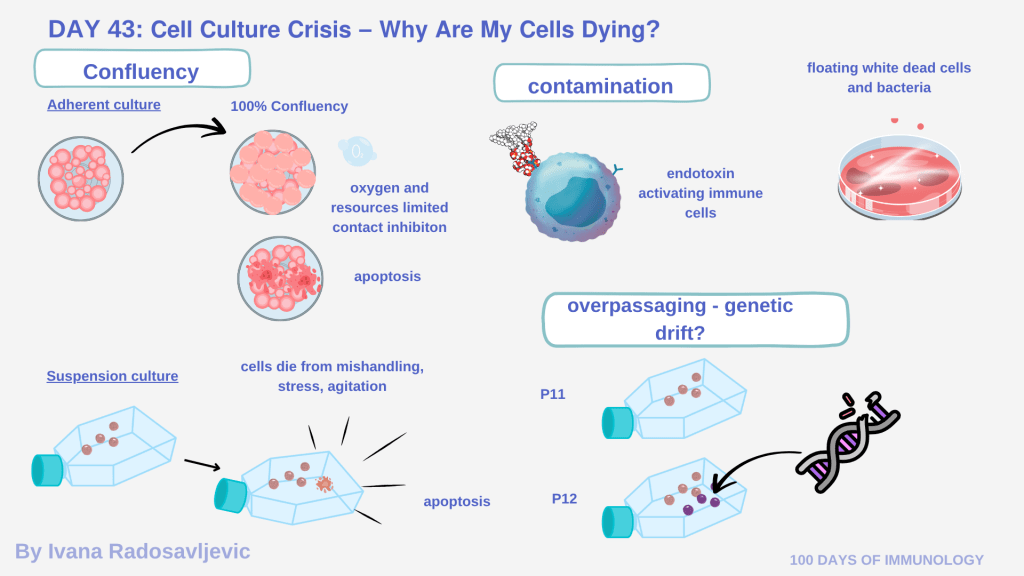
Even the most skilled cell biologists sometimes face the heartbreaking view of floating debris in their culture flasks – cell death. Understanding why cells die and how to prevent it is mandatory for maintaining reproducible experiments, especially in immunology and cell therapy research.
𝗖𝗼𝗻𝗳𝗹𝘂𝗲𝗻𝗰𝘆 𝗮𝗻𝗱 𝗢𝘃𝗲𝗿𝗴𝗿𝗼𝘄𝘁𝗵
In adherent cell cultures, cells require a balance between proliferation and available surface area. Once cells reach 100% 𝘤𝘰𝘯𝘧𝘭𝘶𝘦𝘯𝘤𝘺, nutrients and oxygen become limited, waste accumulates, and contact inhibition pathways are triggered, leading to apoptosis or senescence [1]. On the other hand, subconfluent cultures may not communicate effectively via cell–cell or paracrine signaling, altering gene expression and phenotype stability. (See https://lnkd.in/eb_GZSpD.)
𝗦𝘂𝘀𝗽𝗲𝗻𝘀𝗶𝗼𝗻 𝗖𝘂𝗹𝘁𝘂𝗿𝗲 𝗦𝘁𝗿𝗲𝘀𝘀
In suspension cultures, cell death often results from shear stress, inadequate agitation, or poor nutrient diffusion. Shaking or stirring that’s too vigorous damages membranes [2]. 𝘐𝘯𝘤𝘰𝘳𝘳𝘦𝘤𝘵 𝘴𝘦𝘦𝘥𝘪𝘯𝘨 𝘥𝘦𝘯𝘴𝘪𝘵𝘪𝘦𝘴 or unoptimized growth media (e.g., THP-1 or NALM6) can also promote spontaneous apoptosis.
𝗖𝗼𝗻𝘁𝗮𝗺𝗶𝗻𝗮𝘁𝗶𝗼𝗻 – 𝗧𝗵𝗲 𝗜𝗻𝘃𝗶𝘀𝗶𝗯𝗹𝗲 𝗞𝗶𝗹𝗹𝗲𝗿
As discussed in https://lnkd.in/e29MU53A, bacterial, fungal, or mycoplasma contamination can devastate cultures. Cloudy medium, sudden pH changes, or altered morphology often appear only after the damage is done [3]. Even endotoxin traces from reagents can trigger inflammatory cell death pathways.
𝗢𝘃𝗲𝗿𝗽𝗮𝘀𝘀𝗮𝗴𝗶𝗻𝗴 𝗮𝗻𝗱 𝗚𝗲𝗻𝗲𝘁𝗶𝗰 𝗗𝗿𝗶𝗳𝘁
Continuous passaging can change cell phenotype, gene expression, and even chromosomal stability – critical in immunology when modeling macrophage polarization, cytokine secretion, or immune cell signaling [4].
𝗥𝗲𝗳𝗹𝗲𝗰𝘁𝗶𝗼𝗻 𝗳𝗼𝗿 𝗜𝗺𝗺𝘂𝗻𝗼𝗹𝗼𝗴𝘆
In immunological studies, maintaining cell viability is fundamental for functional assays such as ELISA, multiplex cytokine profiling, and flow cytometry. Dead or stressed cells release unwanted cytokines, skewing readouts and masking true immune responses.
𝗤𝘂𝗲𝘀𝘁𝗶𝗼𝗻 𝗳𝗼𝗿 𝘁𝗵𝗲 𝗔𝘂𝗱𝗶𝗲𝗻𝗰𝗲: What’s your most memorable ´cell culture crisis´?
Stay tuned for 𝗗𝗮𝘆 𝟰𝟰: 𝗟𝗮𝗯 𝗦𝗮𝗳𝗲𝘁𝘆 𝗮𝗻𝗱 𝗚𝗼𝗼𝗱 𝗦𝗰𝗶𝗲𝗻𝘁𝗶𝗳𝗶𝗰 𝗣𝗿𝗮𝗰𝘁𝗶𝗰𝗲
𝗥𝗲𝗳𝗲𝗿𝗲𝗻𝗰𝗲𝘀:
1. DOI:10.1002/9780470649367
2. DOI:10.4324/9780203427835
3. doi: 10.1023/A:1022913015916
4. DOI:10.2144/000112598
hashtag#100DaysofImmunology hashtag#CellCulture hashtag#Immunology hashtag#LabTips hashtag#AdherentCells hashtag#SuspensionCells hashtag#Contamination hashtag#CellDeath hashtag#Reproducibility hashtag#BiomedicalResearch
 Ivana Radosavljević | Immunotherapy Scientist | Living and Breathing Immunology