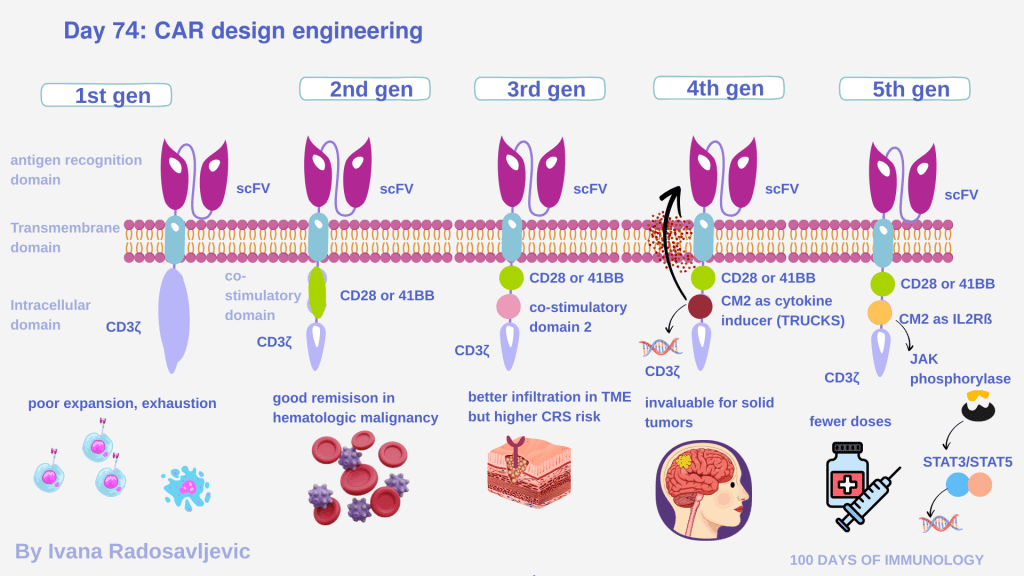
Chimeric Antigen Receptors (CARs) have undergone evolution over the past two decades [1–3].
1st Generation CARs
Contain only the CD3ζ signaling domain for T cell activation and targeting tumor cells. Limitation: In vivo, these T cells have poor persistence, limited expansion, and are quickly exhausted.
2nd Generation CARs
Apart from CD3ζ, added a single costimulatory domain, CD28 or 4-1BB. This drastically improves proliferation, survival, and cytokine production 𝘪𝘯 𝘷𝘪𝘷𝘰. For patients, this means more durable remissions in hematologic malignancies.
𝟯𝗿𝗱 𝗴𝗲𝗻𝗲𝗿𝗮𝘁𝗶𝗼𝗻 𝗖𝗔𝗥𝘀
Combine two co-stimulatory domains further enhancing T cell activation and persistence. These withstand the immunosuppressive TME. Clinically, higher response rates, but also a potentially increased risk of cytokine release syndrome (CRS) due to more potent activation [4].
4th Generation CARs
Also called TRUCKs, introduce inducible expression of cytokines like IL-12. This allows T cells to actively modulate the TME (like 3rd gen), recruiting innate immune cells and overcoming local immunosuppression. 𝘐𝘯 𝘷𝘪𝘷𝘰, this innovation can be especially valuable for solid tumors, which are difficult to infiltrate.
5th Generation CARs
Integrate cytokine receptor signaling motifs (e.g., IL-2Rβ chain with STAT3/5 recruitment) to combine antigen recognition, costimulation, and cytokine-mediated proliferation in a single construct. For patients, this means longer-lasting remissions and potentially fewer doses. Limitations: Manufacturing challenges and costs. Each CAR-T product must be produced under stringent GMP conditions, and 5th gen constructs may require more sophisticated quality control, viral vectors, or non-viral delivery systems.
𝗖𝗼𝗻𝗰𝗲𝗽𝘁𝘂𝗮𝗹 𝘁𝗵𝗶𝗻𝗸𝗶𝗻𝗴:
I often wonder: could we fine-tune killing mechanisms, selectively triggering perforin/granzyme without overproducing inflammatory cytokines? Could modular, logic-gated CARs allow different responses based on the tumor antigen context, reducing collateral damage to healthy cells?
Question for The Audience: When designing the next gen CARs, how would you balance complexity, and patient safety against solid tumors?
Stay tuned for 𝗗𝗮𝘆 𝟳𝟱: 𝗢𝗽𝘁𝗼𝗴𝗲𝗻𝗲𝘁𝗶𝗰𝘀 𝗶𝗻 𝗖𝗲𝗹𝗹𝘂𝗹𝗮𝗿 𝗮𝗻𝗱 𝗜𝗺𝗺𝘂𝗻𝗼𝘁𝗵𝗲𝗿𝗮𝗽𝘆 𝗥𝗲𝘀𝗲𝗮𝗿𝗰𝗵
𝗥𝗲𝗳𝗲𝗿𝗲𝗻𝗰𝗲𝘀:
1. DOI: 10.1126/science.aar6711
2. DOI: 10.1016/j.cell.2017.01.016
3. DOI: 10.1172/JCI80010
4. DOI: 10.1038/nm.4478
#CAR_T #Immunotherapy #CellTherapy #SyntheticBiology #NextGenCAR #TRUCK #TCellEngineering #CancerImmunology #GeneTherapy #ImmunoOncology #100DaysofImmunology
 Ivana Radosavljević | Immunotherapy Scientist | Living and Breathing Immunology