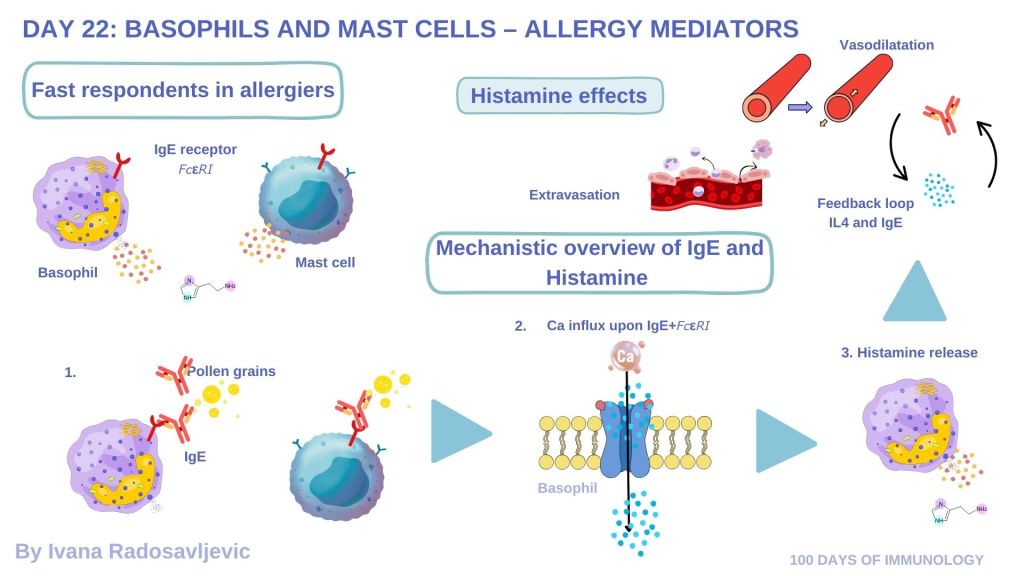
Basophils and mast cells are rare effector cells that act as first responders in allergic reactions. They are characterized by their 𝘩𝘪𝘨𝘩-𝘢𝘧𝘧𝘪𝘯𝘪𝘵𝘺 𝘐𝘨𝘌 𝘳𝘦𝘤𝘦𝘱𝘵𝘰𝘳 (𝘍𝘤ε𝘙𝘐) 𝘦𝘹𝘱𝘳𝘦𝘴𝘴𝘪𝘰n and their 𝘤𝘢𝘱𝘢𝘤𝘪𝘵𝘺 𝘧𝘰𝘳 𝘳𝘢𝘱𝘪𝘥 𝘳𝘦𝘭𝘦𝘢𝘴𝘦 𝘰𝘧 𝘩𝘪𝘴𝘵𝘢𝘮𝘪𝘯𝘦, 𝘱𝘳𝘰𝘵𝘦𝘢𝘴𝘦𝘴, 𝘢𝘯𝘥 𝘭𝘪𝘱𝘪𝘥 𝘮𝘦𝘥𝘪𝘢𝘵𝘰𝘳𝘴. Together, they orchestrate immediate 𝘩𝘺𝘱𝘦𝘳𝘴𝘦𝘯𝘴𝘪𝘵𝘪𝘷𝘪𝘵𝘺 𝘢𝘯𝘥 𝘭𝘢𝘵𝘦-𝘱𝘩𝘢𝘴𝘦 𝘢𝘭𝘭𝘦𝘳𝘨𝘪𝘤 𝘳𝘦𝘴𝘱𝘰𝘯𝘴𝘦𝘴 [1].
𝗠𝗲𝗰𝗵𝗮𝗻𝗶𝘀𝘁𝗶𝗰 𝗢𝘃𝗲𝗿𝘃𝗶𝗲𝘄: 𝗜𝗴𝗘 𝗮𝗻𝗱 𝗛𝗶𝘀𝘁𝗮𝗺𝗶𝗻𝗲 𝗥𝗲𝗹𝗲𝗮𝘀𝗲
Mast cells and basophils become sensitized w𝘩𝘦𝘯 𝘐𝘨𝘌 𝘢𝘯𝘵𝘪𝘣𝘰𝘥𝘪𝘦𝘴, 𝘣𝘰𝘶𝘯𝘥 𝘷𝘪𝘢 𝘍𝘤ε𝘙𝘐, 𝘳𝘦𝘤𝘰𝘨𝘯𝘪𝘻𝘦 𝘴𝘱𝘦𝘤𝘪𝘧𝘪𝘤 𝘢𝘭𝘭𝘦𝘳𝘨𝘦𝘯𝘴. Upon re-exposure to the same allergen, receptor cross-linking triggers intracellular signaling cascades involving Lyn and Syk kinases, leading to calcium mobilization and degranulation [2].
Histamine release leads to vasodilation, increased vascular permeability, smooth muscle contraction, and pruritus [3]. Mast cells and basophils secrete cytokines (e.g. IL-4, IL-13), reinforcing IgE production [4].
𝗚𝗲𝗿𝗺𝗮𝗻 𝗥𝗲𝘀𝗲𝗮𝗿𝗰𝗵𝗲𝗿𝘀
Marcus Maurer (Charité – Universitätsmedizin Berlin) has extensively studied mast cells in chronic urticaria and histamine-mediated skin inflammation [5].
Torsten Zuberbier (Charité – Universitätsmedizin Berlin) is a leading researcher on mast cell-driven allergic diseases and clinical allergy guidelines.
Axel Lorentz (University of Stuttgart-Hohenheim) investigates basophil and mast cell activation pathways, with a focus on IgE-dependent and independent triggers in food allergy.
𝗦𝗽𝗲𝗰𝘂𝗹𝗮𝘁𝗶𝘃𝗲 𝗛𝘆𝗽𝗼𝘁𝗵𝗲𝘀𝗶𝘀
I propose the 𝘈𝘮𝘱𝘭𝘪𝘧𝘪𝘦𝘳 𝘏𝘺𝘱𝘰𝘵𝘩𝘦𝘴𝘪𝘴 𝘰𝘧 𝘐𝘨𝘌-𝘏𝘪𝘴𝘵𝘢𝘮𝘪𝘯𝘦 𝘊𝘳𝘰𝘴𝘴𝘵𝘢𝘭𝘬 : While histamine is viewed as the endpoint of mast cell/basophil activation, histamine itself may act upstream by modulating IgE receptor sensitivity via H₄ receptor feedback loops. Histamine is not only an effector mediator but also a regulator of FcεRI threshold sensitivity. Such a loop could explain why chronic allergic conditions (e.g. urticaria) persist even with minimal allergen exposure, as mast cells remain “pre-primed” in histamine-rich environments.
Stay tuned for 𝗗𝗮𝘆 𝟮𝟯: γδ 𝗧 𝗖𝗲𝗹𝗹𝘀 – 𝗡𝗼𝗻-𝗖𝗹𝗮𝘀𝘀𝗶𝗰𝗮𝗹 𝗧 𝗖𝗲𝗹𝗹 𝗗𝗲𝗳𝗲𝗻𝗱𝗲𝗿𝘀
𝗥𝗲𝗳𝗲𝗿𝗲𝗻𝗰𝗲𝘀
1. DOI: 10.1038/nm.2755
2. DOI: 10.1038/nri1782
3. DOI: 10.1016/s0091-6749(97)70089-7
4. DOI: 10.1038/nri2072
5. DOI: 10.1111/j.1398-9995.2010.02496.x
hashtag#100DaysOfImmunology hashtag#Basophils hashtag#MastCells hashtag#IgE hashtag#Histamine hashtag#Allergy hashtag#GermanResearchers hashtag#FcεRI hashtag#Immunology hashtag#mechanisticimmunology
 Ivana Radosavljević | Immunotherapy Scientist | Living and Breathing Immunology