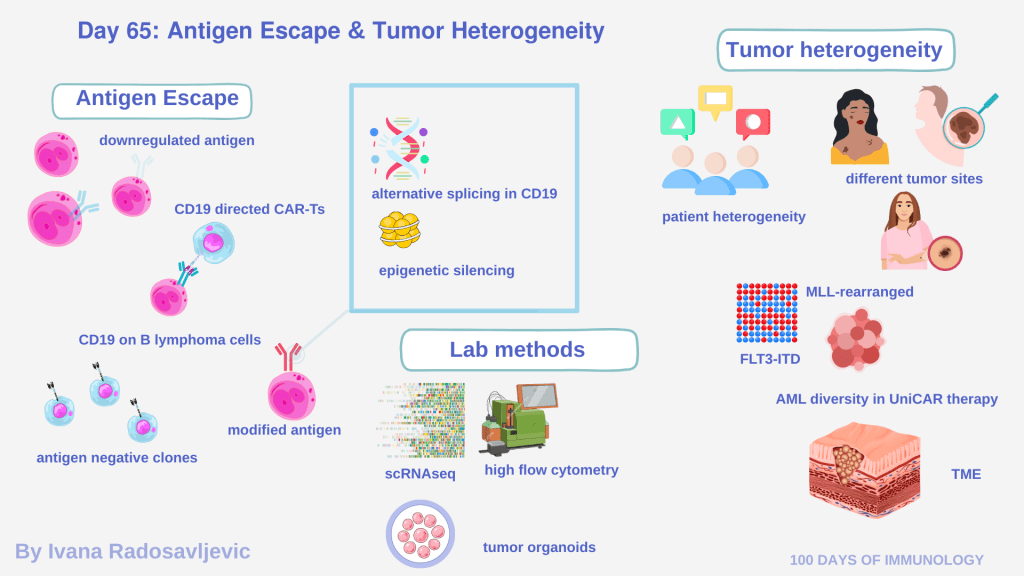
𝗔n𝘁𝗶𝗴𝗲𝗻 𝗘𝘀𝗰𝗮𝗽𝗲: 𝗠𝗲𝗰𝗵𝗮𝗻𝗶𝘀𝘁𝗶𝗰 𝗢𝘃𝗲𝗿𝘃𝗶𝗲𝘄
Antigen escape occurs when tumor cells los𝘦, down𝘳𝘦g𝘶𝘭a𝘵e, or 𝘮𝘰𝘥𝘪fied t𝘩𝘦 t𝘢𝘳𝘨𝘦𝘵 𝘢𝘯𝘵i𝘨𝘦n 𝘰f 𝘢 t𝘩𝘦𝘳𝘢𝘱𝘺. Selective pressure from treatments such as CD19-directed CAR-Ts can lead to outgrowth of antigen-negative clones. Mechanisms:
• genetic mutations creating alternative splice variants (e.g. CD19) [1]
• epigenetic silencing
• lineage switching (e.g. B-ALL to myeloid phenotypes)
• trogocytosis, reducing antigen density on tumour cells [2]
Tumor 𝗛𝗲𝘁erogeneity
Tumors are composed of 𝘥𝘪𝘷𝘦𝘳𝘴𝘦 𝘴𝘶𝘣𝘤𝘭𝘰𝘯𝘢𝘭 𝘱𝘰𝘱𝘶𝘭𝘢𝘵𝘪𝘰𝘯s with distinct genotypes, phenotypes, and antigen profiles (between patients, tumor sites, and even within a single lesion).
In solid tumours, the microenvironment also varies. A tumor cell outside this context is often not ´tumorigenic´, the niche defines its behavior.
𝗖𝗔𝗥-𝗧 Example: Yescarta (Axi-Cel)
Yescarta targets CD19 and is effective in DLBCL, where malignant cells circulate systemically and share this antigen. 30–60% of patients relapse due to CD19 modulation or loss [3], and healthy B cells are also depleted due to on-target/off-tumor effects.
𝗨𝗻𝗶𝗖𝗔𝗥 and 𝗔𝗠𝗟 Diversity
AML illustrates extreme heterogeneity, with multiple molecular subtypes (e.g. FLT3-ITD, MLL-rearranged). Modular platforms such as UniCAR aim to address this with switchable targeting, yet no antigen is uniformly expressed across AML populations [4].
Bias in Clinical Trials
Demographic underrepresentation:
• Women, pregnant/lactating individuals
• paediatric patients
are frequently excluded.
• Most genomic datasets overrepresent individuals of European ancestry.
These gaps limit our understanding of antigen distribution and treatment response.
𝗟𝗮𝗯𝗼𝗿𝗮𝘁𝗼𝗿𝘆 𝗔𝗽𝗽𝗿𝗼𝗮𝗰𝗵𝗲𝘀 𝘁𝗼 𝗦𝘁𝘂𝗱𝘆 𝗛𝗲𝘁𝗲𝗿𝗼𝗴𝗲𝗻𝗲𝗶𝘁𝘆 𝗮𝗻𝗱 𝗘𝘀𝗰𝗮𝗽𝗲
Tools:
• scRNA seq
• CyTOF and high-dimensional flow cytometry
• spatial transcriptomics
• tumor organoids
• longitudinal liquid biopsies
These methods inform next-generation immunotherapies targeting multiple antigens.
𝗤𝘂𝗲𝘀𝘁𝗶𝗼𝗻 𝗳𝗼𝗿 𝘁𝗵𝗲 𝗔𝘂𝗱𝗶𝗲𝗻𝗰𝗲
Should future immunotherapies focus on multi-antigen targeting, or is TME reprogramming the more promising strategy?
Stay tuned for 𝗗𝗮𝘆 𝟲𝟲: 𝗖𝗼𝗺𝗯𝗶𝗻𝗮𝘁𝗶𝗼𝗻 𝗥𝗲𝗴𝗶𝗺𝗲𝗻𝘀 𝗶𝗻 𝗖𝗮𝗻𝗰𝗲𝗿 𝗜𝗺𝗺𝘂𝗻𝗼𝘁𝗵𝗲𝗿𝗮𝗽𝘆
𝗥𝗲𝗳𝗲𝗿𝗲𝗻𝗰𝗲𝘀
1. DOI: 10.1158/2159-8290.CD -15-1020
2. DOI: 10.1126/scitranslmed.aau5907
3. DOI: 10.1056/NEJMoa1707447
4. DOI: 10.1182/blood.2020009759
hashtag#Immunology hashtag#CancerBiology hashtag#AntigenEscape hashtag#TumorHeterogeneity hashtag#CAR hashtag#UniCAR hashtag#ImmunoOncology hashtag#Hematology hashtag#SolidTumors hashtag#TME hashtag#AML hashtag#PrecisionMedicine hashtag#100DaysofImmunology
 Ivana Radosavljević | Immunotherapy Scientist | Living and Breathing Immunology