I was walking down the street in September when it happened. I inhaled pollen and I was sneezing, coughing, and crying in public. Tears rolling, nose running. I wasn’t emotional. This was my immune system reacting.
A textbook example of allergy, a condition in which the immune system creates a disproportionate response to a harmless antigen.
Mechanistic Basis of Allergic Reactions:
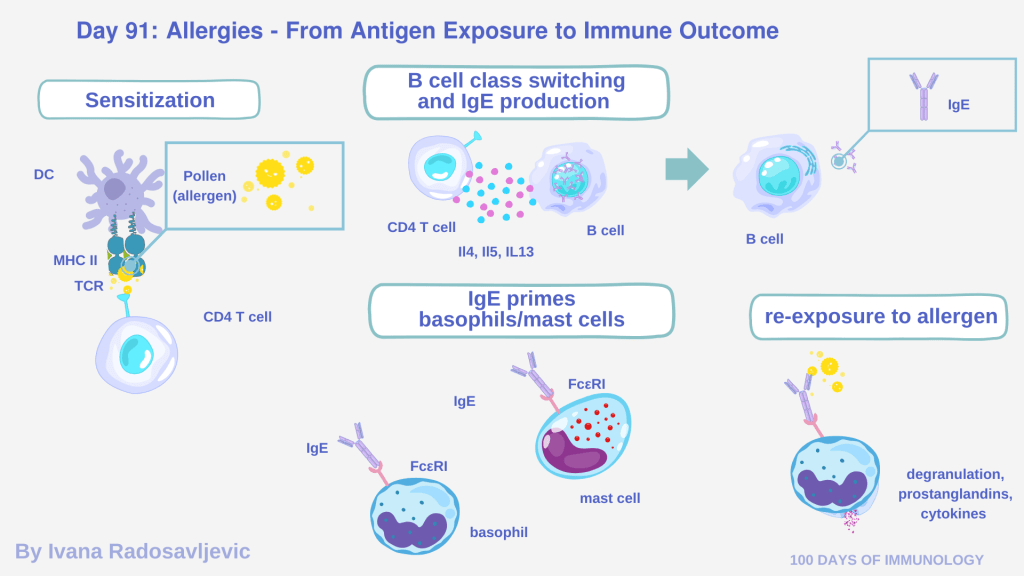
Allergies are type I hypersensitivity reactions, driven by IgE-mediated immune responses. The process begins with sensitization: antigen-presenting cells (dendritic cells) process the allergen and promote differentiation of naïve CD4⁺ T cells into Th2 cells. Th2 cells secrete cytokines IL-4, IL-5, and IL-13, which induce B cells to class-switch and produce allergen-specific IgE [1]. IgE antibodies bind to high-affinity FcεRI receptors on mast cells and basophils. Upon re-exposure to the same allergen, crosslinking of IgE triggers rapid degranulation, releasing histamine, leukotrienes, prostaglandins, and cytokines. The result is vasodilation, increased vascular permeability, bronchoconstriction, mucus secretion, and pruritus (allergic disease) [1,2].
𝗖𝗲𝗹𝗹𝘂𝗹𝗮𝗿 𝗽𝗹𝗮𝘆𝗲𝗿𝘀
• Mast cells and basophils: immediate effector cells
• Th2 CD4⁺ T cells: orchestrate allergic polarization
• B cells and plasma cells: produce allergen-specific IgE
• Eosinophils: contribute to tissue damage and chronic inflammation
• Epithelial and endothelial cells: amplify inflammation via cytokine/chemokine release
𝗪h𝗲𝗻 𝗮l𝗹𝗲𝗿𝗴𝗶𝗲𝘀 𝗯𝗲𝗰𝗼𝗺𝗲 𝗹𝗶𝗳𝗲-𝘁𝗵𝗿𝗲𝗮𝘁𝗲𝗻𝗶𝗻𝗴
Anaphylaxis is a rapid, systemic hypersensitivity reaction characterized by hypotension, airway obstruction, and shock. Common triggers include bee stings, peanuts, shellfish, and certain drugs [3].
Popular media frequently portrays food allergies (nut allergies) as jokes or inconveniences. This is dangerous misinformation [3,4].
𝗪𝗵𝘆 𝗮𝗹𝗹𝗲𝗿𝗴𝗶e𝘀 𝗺𝗮𝘁t𝗲𝗿 𝗯𝗲𝘆𝗼𝗻𝗱 𝘀𝘆𝗺𝗽𝘁𝗼𝗺𝘀
Allergic diseases reflect a fundamental concept in immunology: immune outcome is determined not only by antigen identity, but by dose, context, timing, and host predisposition.
𝗤𝘂𝗲𝘀𝘁𝗶𝗼𝗻 𝗳𝗼𝗿 𝘁𝗵𝗲 𝗮𝘂𝗱𝗶𝗲𝗻𝗰𝗲
Should we think of allergies primarily as immune “errors,” or as the cost of an immune system optimized for survival in a pathogen-rich evolutionary past?
Stay tuned for 𝗗𝗮𝘆 𝟵𝟮: 𝗠𝗲𝗰𝗵𝗮𝗻𝗶𝘀𝗺𝘀 𝗠𝗮𝘁𝘁𝗲𝗿 – 𝗔 𝗥𝗲𝗰𝗮𝗽 𝗼𝗳 𝗠𝗼𝗹𝗲𝗰𝘂𝗹𝗮𝗿 𝗮𝗻𝗱 𝗖𝗲𝗹𝗹𝘂𝗹𝗮𝗿 𝗜𝗺𝗺𝘂𝗻𝗼𝗹𝗼𝗴𝘆
𝗥𝗲𝗳𝗲𝗿𝗲𝗻𝗰𝗲𝘀
1. DOI: 10.1038/nm.2755
2. DOI: 10.1016/j.jaci.2010.11.030
3. DOI: 10.1097/WOX.0b013e318211496c
4. DOI: 10.1016/j.jaip.2017.06.031
#Immunology #Allergy #Hypersensitivity #IgE #MastCells #Th2 #Anaphylaxis #ClinicalImmunology #ImmuneRegulation #100DaysOfImmunology
 Ivana Radosavljević | Immunotherapy Scientist | Living and Breathing Immunology