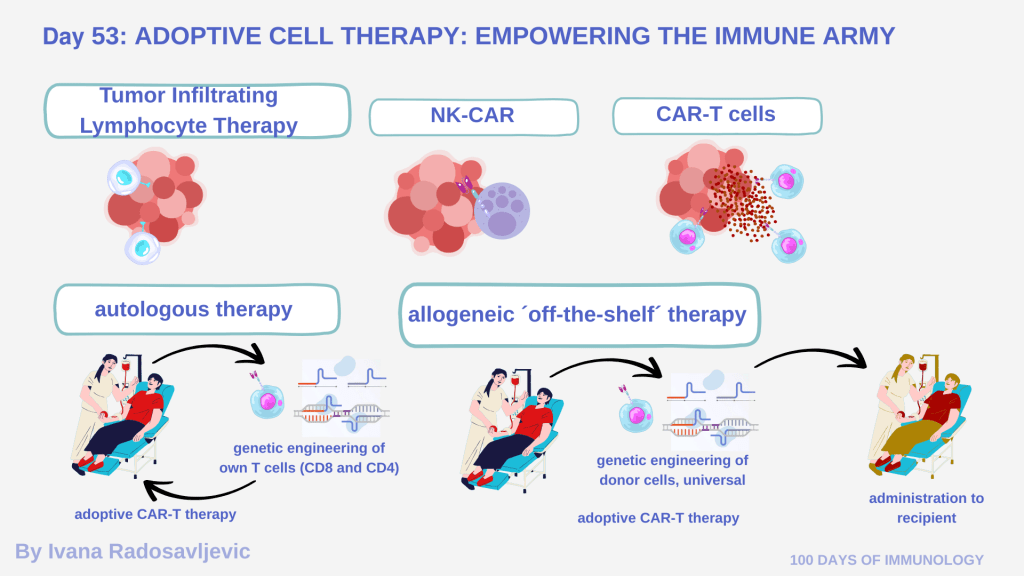
Adoptive cell therapy (ACT) is a cornerstone of modern immuno-oncology, where immune cells are isolated, expanded, and reintroduced into patients to target cancer. ACT encompasses several forms: tumor-infiltrating lymphocytes (TILs), engineered T cells (CAR-T, TCR-T), natural killer (NK) cells, and macrophage-based therapies [1][2].
𝗔𝘂𝘁𝗼𝗹𝗼𝗴𝗼𝘂𝘀 𝘃𝘀. 𝗔𝗹𝗹𝗼𝗴𝗲𝗻𝗲𝗶𝗰 𝗔𝗽𝗽𝗿𝗼𝗮𝗰𝗵𝗲𝘀
𝘈𝘶𝘵𝘰𝘭𝘰𝘨𝘰𝘶𝘴 𝘈𝘊𝘛 uses a patient’s own cells, minimizing graft-versus-host disease (GVHD) risk and immunogenicity. However, patient-derived cells may be functionally exhausted or in limited quantities [3].
𝘈𝘭𝘭𝘰𝘨𝘦𝘯𝘦𝘪𝘤 𝘈𝘊𝘛 employs donor cells, enabling ´off-the-shelf´ products with immediate availability, but carries higher risk of immune rejection or GVHD [2][4].
𝗠𝗲𝗰𝗵𝗮𝗻𝗶𝘀𝘁𝗶𝗰 𝗜𝗻𝘀𝗶𝗴𝗵𝘁𝘀
In CAR-T therapy, T cells are engineered with chimeric antigen receptors to recognize tumor antigens independent of MHC [5]. Upon infusion, CAR-T cells proliferate, secrete cytotoxic molecules (perforin, granzymes), and recruit other immune components.
𝗙𝘂𝗻𝗻𝘆 𝗮𝗻𝗲𝗰𝗱𝗼𝘁𝗲: When I first heard about autologous ACT, I imagined it like aesthetic surgery—moving fat from one body site to another! The reality of isolating, expanding, and reinfusing immune cells is far more intricate (and fascinating).
𝗦𝗽𝗲𝗰𝘂𝗹𝗮𝘁𝗶𝘃𝗲 𝗵𝘆𝗽𝗼𝘁𝗵𝗲𝘀𝗶𝘀: Could combinatorial ACT – mixing CAR-T, CAR-NK, and macrophage-based therapies – synergistically reshape the tumor microenvironment to overcome immune suppression, particularly in solid tumors resistant to monotherapies? Preclinical data suggest enhanced infiltration and cytokine-mediated remodeling, but the safety profile and optimal dosing remain open questions [2][5].
Stay tuned for 𝗗𝗮𝘆 𝟱𝟰: 𝗖𝗔𝗥-𝗧 𝗼𝘃𝗲𝗿𝘃𝗶𝗲𝘄
𝗥𝗲𝗳𝗲𝗿𝗲𝗻𝗰𝗲𝘀:
1. DOI: 10.1126/science.aaa4967
2. DOI: 10.1056/NEJMra1706169
3. DOI: 10.1016/S0022-1759(87)80018-2
4. DOI: 10.1182/blood.2022016200
5. DOI: 10.1038/s41417-021-00418-1
#100DaysOfImmunology #AdoptiveCellTherapy #CAR_T #Immunotherapy #TILs #NK_CAR #MacrophageCAR #AutologousVsAllogeneic #CancerImmunology #TumorMicroenvironment
 Ivana Radosavljević | Immunotherapy Scientist | Living and Breathing Immunology